A budget spin bike setup is rarely a single purchase. You buy the bike, ride it twice, and then a second shopping list appears: a saddle that does not bruise you, a wrench that keeps the frame fasteners honest, and something soft under your knees for the floor work that comes with any cycling routine. The hard part is telling which of those extras changes how often you ride and which one just takes up drawer space.
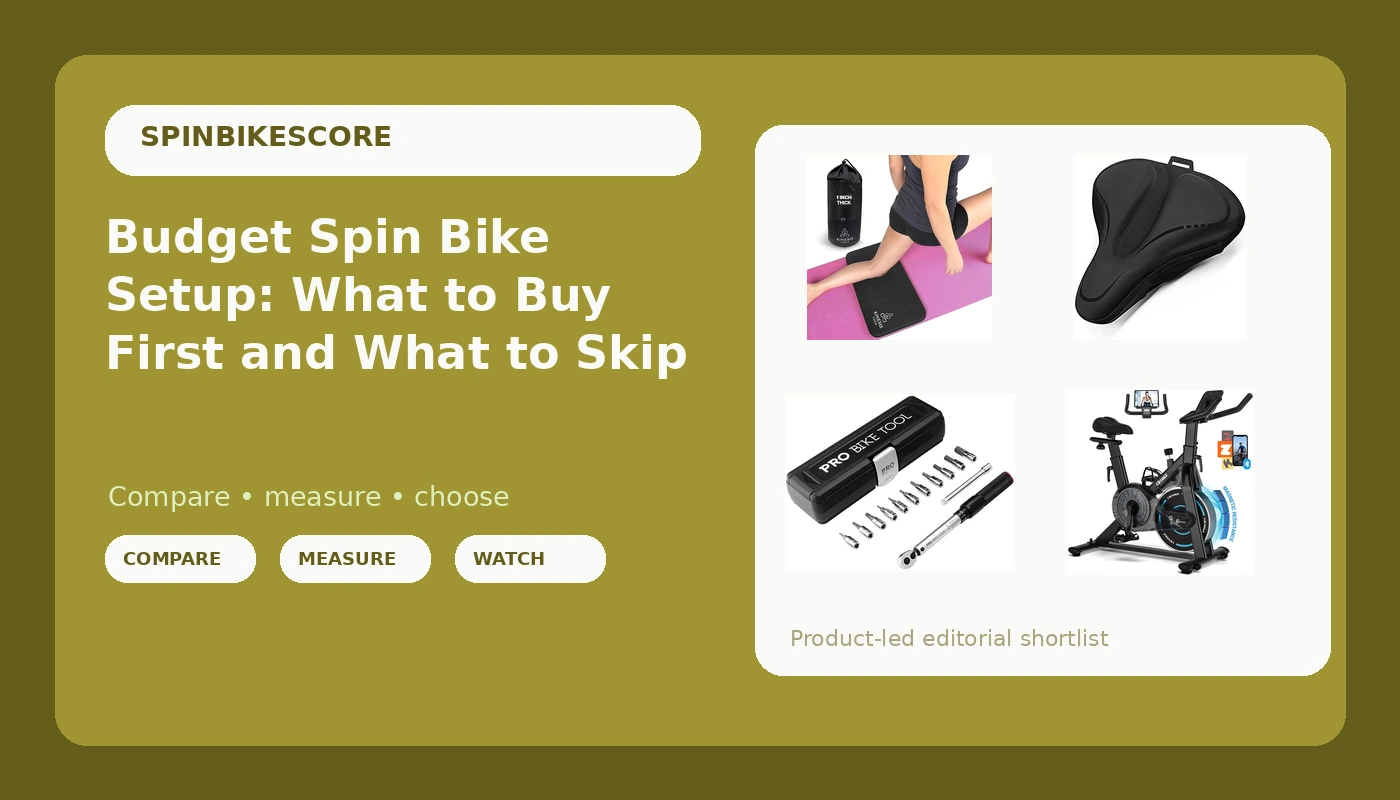
This is a plain look at four items that tend to live in the same home cardio corner: a magnetic resistance exercise bike, a wide gel seat cushion, a small torque wrench set, and an extra thick knee pad. None of them is a magic upgrade. Each one solves a specific, predictable problem, and understanding the problem is most of the decision.
Related: How to Fit a Spin Bike to Your Body →
Quick answer
Buy the bike first, then treat the seat, the wrench, and the knee pad as fit and maintenance items rather than accessories. A stationary bike with adjustable magnetic resistance and a 300 pound weight capacity covers the riding itself. A wide gel cushion addresses the most common comfort complaint on a stock saddle. A torque wrench set in the 2.2 to 16.9 Nm range covers the small fasteners on a home bike, where over tightening damages threads faster than under tightening ever will. The knee pad only earns its place if your off bike routine puts your knees on a hard floor.
Four useful options
| Model | Best fit | What stands out |
|---|---|---|
| Exercise Bike, CHAOKE Quiet Adjustable Magnetic Resistance Stationary Bike for Home Cardio with App Compatible, 300LB Weight Capacity Indoor Cycling Bike with Comfortable Seat & Digital Display | Riders who want one machine for home cardio | Adjustable magnetic resistance, app compatibility, 300LB weight capacity, digital display |
| ANZOME Bike Seat Cushion, Wide Foam & Extra Soft Gel Exercise Bike Seat Cushion for Women Men Everyone, Compatible with Cruiser, Stationary Bike, Exercise Bike, Fit Wide 8.5-10in(Rain Cover Included) | Riders whose stock saddle hurts before the warm up ends | Wide foam and gel layers, fits wide 8.5-10in saddles, rain cover included |
| PRO BIKE TOOL Bike Torque Wrench Set - 1/4 Inch Drive, 2.2-16.9 Nm | Owners who assemble and re-check their own bike | 1/4 inch drive, 2.2-16.9 Nm range, sized for small fasteners |
| Kinesis Yoga Knee Pad Cushion - Extra Thick 1 inch (25mm) Exercise Knee Pad | Riders doing floor work, stretching, or recovery | Extra thick 1 inch (25mm) padding for knees and elbows |
The bike: CHAOKE Exercise Bike
The bike decides whether you have a home cardio setup at all, so it gets the most scrutiny. Magnetic resistance is the right mechanism for a machine you plan to ride several times a week, because there is no friction pad to wear down. What a listing cannot tell you is how the frame behaves when you stand up and push. Weight capacity, frame geometry, and stabilizer width all feed into that, and the honest test is to put your weight over the pedals before you commit.
The seat fix: ANZOME Bike Seat Cushion
A cushion is the cheapest way to change how a bike feels, and it is also the most commonly mis-bought item. Measure your saddle at its widest point before ordering. Too narrow and it will not cover the edges, too wide and it shifts under you, and a sliding cushion is worse than the firm one you started with. The included rain cover is a small detail that matters if the bike sits outside a garage.
The maintenance tool: PRO BIKE TOOL Bike Torque Wrench Set
A torque wrench sounds like a workshop item until you have rounded a seat post bolt with a hex key. Home bikes use small fasteners with low torque values, and the gap between snug and stripped is narrow. A set spanning 2.2 to 16.9 Nm covers most of what you will touch. Use the value printed in your bike manual, and if the manual does not list one, tighten in small increments and check that nothing moves afterward.
The floor cushion: Kinesis Yoga Knee Pad Cushion
Floor work is where a knee pad stops being a yoga accessory and becomes part of a cycling routine. Stretching hip flexors, holding a plank, or doing clamshells on a hard surface puts pressure directly on the kneecap. An inch of foam costs less than a single missed training week, and it packs flat next to the bike.
Prices and availability may change. Product images, names, and retailer links are matched to verified listings. No current price, rating, stock status, or measured result is stated here without current evidence.
What magnetic resistance changes, and what it does not
Magnetic resistance is the feature that gets the most marketing attention on a home bike, so it is worth separating the real benefit from the noise.
The real benefit is contact-free braking. Magnets create resistance without touching a wear surface, so there is no pad to replace, no felt dust on the frame, and no change in feel as a pad flattens over months. On a bike ridden three or four times a week, that consistency is worth more than the label on the box.
What magnetic resistance does not do is make a bike stable. Stability comes from frame weight, the footprint of the stabilizers, and how firmly the seat post and handlebar post lock down. A magnetic bike with a narrow base will still rock when you stand and push. Evaluate those structural details separately from the resistance type.
It also does not make a ride silent. Magnetic resistance removes one noise source, the friction of a pad against a flywheel. It does not remove drivetrain noise, bearing noise, or the sound of a frame flexing under load. A listing that promises silence is describing one component, not the whole machine.
Adjustable range matters more than the mechanism label. You want a knob or lever that moves smoothly from near zero to a resistance heavy enough that you cannot hold a sprint cadence. If resistance jumps or slips at the top of the range, the mechanism type will not rescue the ride.
Fit is three contact points, not one
Fit comes down to three places where your body meets the bike, and each has its own fix.
The saddle comes first because it is where most new riders quit. A stock saddle on a budget bike is usually narrow and firm, fine for a short ride and punishing at mile fifteen. A wide gel cushion adds a foam and gel layer that spreads pressure over a larger area. Measure your saddle at its widest point before ordering, because a cushion that slides is worse than no cushion.
The second contact point is your hands and shoulders. Handlebar height and reach are set with the post and slider, and no accessory fixes a reach that is too long. Set seat height so your knee is slightly bent at the bottom of the pedal stroke, then set the handlebars so your shoulders stay relaxed rather than locked.
The third contact point is your knees, on and off the bike. On the bike, a wide Q-factor or a seat set too low will make knees complain after twenty minutes. Off the bike, floor work puts direct pressure on the kneecap, which is where an extra thick pad earns its place.
Work through this order before you buy anything:
- Set the seat height so the leg is almost straight at the bottom of the stroke.
- Check that the seat post and handlebar post lock down without slipping.
- Measure your saddle width and match a cushion to it.
- Check every frame bolt with a torque wrench set to the value in your manual.
- Re-check those same bolts after the first two weeks of riding.
Setting up the corner without paying twice
- Buy the bike you will actually ride. A machine that fits your height and your room beats a heavier one that does not.
- Fix the saddle before you decide the bike is uncomfortable. Most discomfort is a contact point problem, not a bike problem.
- Keep a small torque wrench with the bike. Home bikes use small fasteners, and the 2.2 to 16.9 Nm range covers most of them.
- Re-torque after week one, then monthly. Vibration loosens hardware, and a loose stabilizer is what makes a bike feel unstable.
- Add floor padding only if your routine includes mat work. It is cheap insurance for knees and elbows, not a performance upgrade.
Which option should you choose?
Choose the Exercise Bike, CHAOKE Quiet Adjustable Magnetic Resistance Stationary Bike when you need one machine for home cardio and want adjustable magnetic resistance, app compatibility, a 300LB weight capacity, and a digital display in a single purchase. Choose the ANZOME Bike Seat Cushion when the stock saddle is the thing stopping you from finishing rides. Choose the PRO BIKE TOOL Bike Torque Wrench Set when you assemble the bike yourself or want to check the fasteners on a schedule. Choose the Kinesis Yoga Knee Pad Cushion when your training includes floor work, stretching, or recovery on a hard surface.
These are complementary items, not competitors. The caveat is that none of them substitutes for a bike that fits you. A cushion cannot fix a frame that is too tall, a torque wrench cannot fix a resistance knob that slips, and a knee pad cannot fix a seat position that is two inches too low. Buy the bike that fits, then solve the contact points one at a time.
The bottom line
The order of purchase matters more than the brand list. Start with a stationary bike that matches your height and your space, set it up properly, and ride it for two weeks. Then fix whatever hurts. For most riders that means a wider, softer saddle surface, a torque wrench to keep the frame tight, and a thick pad for the floor work that supports the riding. The CHAOKE bike covers the machine side with adjustable magnetic resistance and a 300LB weight capacity. The ANZOME cushion, the PRO BIKE TOOL wrench set, and the Kinesis knee pad cover the three things that most often decide whether the bike still gets used in month three. Check current Amazon price on each before you commit, and remember that comfort is the spec that keeps you pedaling.