Most people who buy a home exercise bike are not really shopping for a machine. They are shopping for a habit, and the machine is the thing standing between them and that habit working. That is why the purchase goes wrong so often: the bike that looks strongest on a spec sheet is frequently not the bike that fits the person who will sit on it five days a week.
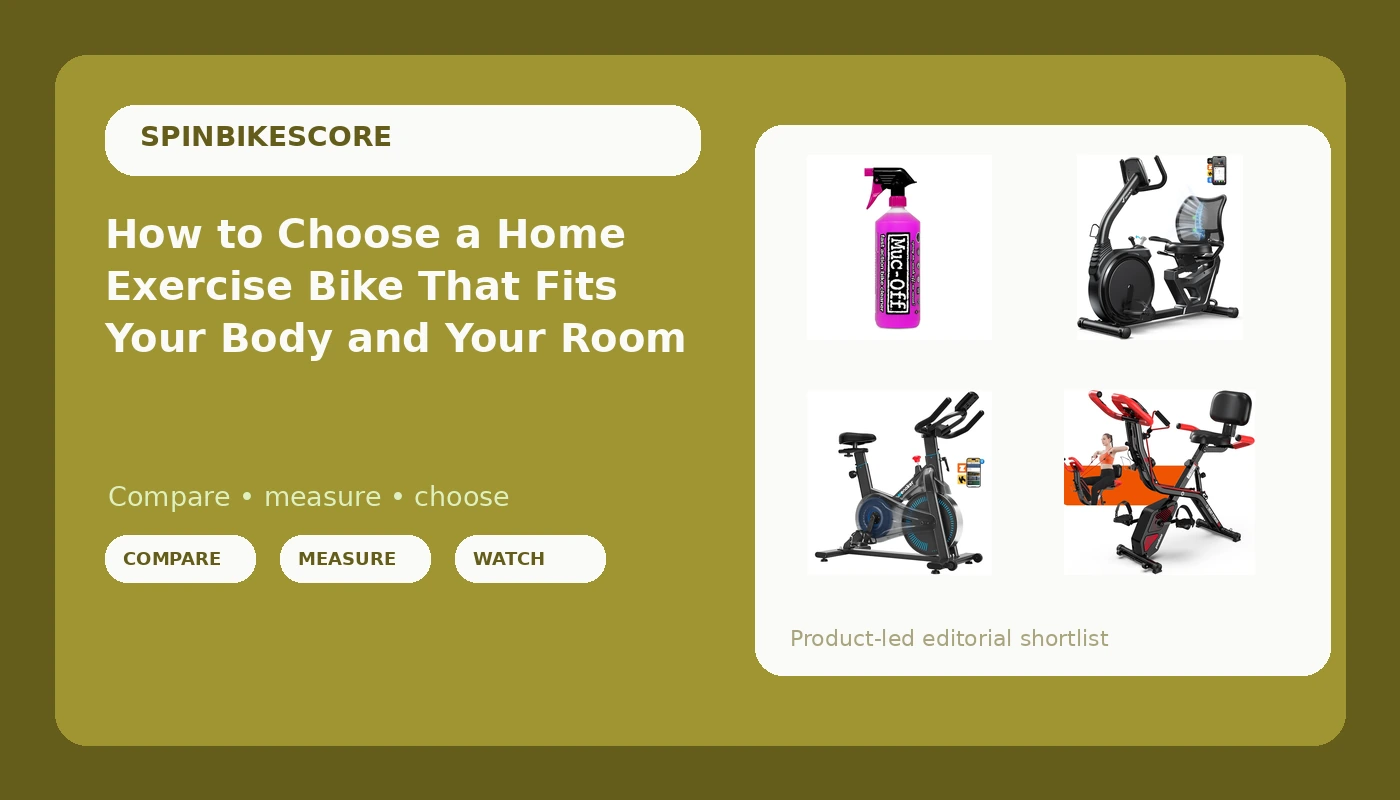
A home exercise bike has to clear four hurdles before anything else matters. The seat and handlebar range has to cover your body. The resistance system has to suit how often you ride. The frame has to fit the room you will actually ride in. And the bike has to be easy enough to maintain that you do not quietly stop using it. The four products below map to four different jobs: a folding upright for tight spaces, an upright with app connectivity, a recumbent for riders who want back support, and a cleaner that keeps whichever bike you choose from grinding itself down.
Related: How to Set Up a Spin Bike for Your Height and Reach →
Quick answer
Fit beats features. A bike whose seat and handlebars adjust into your riding position gets used, while a bike with a heavier flywheel that leaves you reaching for the pedals does not. Past fit, match the resistance type to your ride frequency, since magnetic resistance has no wearing contact surface the way felt pads do. Confirm the footprint against your floor space, and budget for a saddle swap if the stock seat does not suit you. All four products here are reasonable answers to specific problems, and none of them is the right answer for every rider.
4 useful options
| Model | Best fit | What stands out |
|---|---|---|
| pooboo Folding Magnetic X-Bike, Upright Exercise Bike for Home Gym | Small rooms and shared spaces | Folding frame with magnetic resistance |
| Wenoker Exercise Bike, Magnetic Stationary Bike for Home with App Connectivity | Riders who want app connectivity and adjustment range | Magnetic resistance, adjustable seat and handlebar, transport wheels |
| MERACH Recumbent Exercise Bikes for Home High-end | Riders who prefer a reclined, supported position | Recumbent seating position |
| Muc-Off Bike degreaser Bike Cleaner 1L | Keeping any of the above clean and running | 1 liter of bike cleaner and degreaser |
The compact upright: pooboo Folding Magnetic X-Bike, Upright Exercise Bike for Home Gym
The trade-off with any folding frame is rigidity. A hinge is a joint, and joints are where movement starts, so a folding bike can flex more under a hard standing effort than a one-piece frame does. That is not a reason to avoid it, but it is a reason to be honest about how you ride. If your plan is seated steady-state work and the bike has to disappear into a closet afterwards, the folding design earns its compromise. If your plan is standing sprints at high resistance every session, a fixed frame is the safer shape. Either way, the folding mechanism and its hardware are the parts to inspect on a schedule.
The app-connected upright: Wenoker Exercise Bike, Magnetic Stationary Bike for Home with App Connectivity
The listing describes this bike as quiet, and no decibel figure accompanies that word, so treat quiet as something to confirm on the bike you receive rather than as a measured result. Magnetic resistance generally runs quieter than a pad pressing on a spinning flywheel, because nothing is rubbing, but frame creak and pedal noise can still appear on any bike. What matters more here is the adjustable seat and handlebar, since adjustment range is the single feature that decides whether a bike fits a given rider. App connectivity is a nice layer on top, but it cannot fix a bike that is too long or too short for you.
The recumbent option: MERACH Recumbent Exercise Bikes for Home High-end
The recumbent shape solves a problem upright bikes create. With your weight on a small saddle and your torso pitched forward, hands, wrists, and sit bones take load for the whole ride. A recumbent spreads that load across a wider seat with a backrest behind it, which is why riders who find upright saddles uncomfortable often finish more sessions on one. The cost is floor space: a recumbent frame is longer front to back than an upright, and the reclined position means you need room to step in and out from the side. Measure before you commit, because a bike that does not fit the room is a bike that does not get ridden.
The maintenance pick: Muc-Off Bike degreaser Bike Cleaner 1L
Grime is the slow killer of indoor bikes. Sweat is salty, and it lands on paint, steel hardware, and adjustment collars every session. Chain drive bikes collect dust in the lubricant until the drivetrain feels gritty, and that grit is what wears chainrings and cogs. A cleaner and degreaser handles the drivetrain side of that problem; a dry rag after each ride handles the frame side. Follow the label directions, keep liquid out of sealed bearings and out of the resistance assembly, and re-lubricate anything you degrease. It is the least exciting item in this article and the one that most affects how the other three feel in year two.
Prices and availability may change. Product images, names, and retailer links are matched to verified listings. No current price, rating, stock status, or measured result is stated here without current evidence.
Why adjustment range decides whether you ride
Every fit problem on a home exercise bike traces back to the same three numbers: seat height, horizontal distance from saddle to handlebar, and the width between the pedals, often called Q-factor. Seat height is set so that your knee keeps a slight bend at the bottom of the pedal stroke rather than locking out straight or staying deeply flexed. Reach is set so your shoulders stay relaxed and your elbows keep a soft bend instead of locking. Q-factor is the one you cannot adjust, and a stance that is too wide shows up as knee discomfort twenty minutes into a ride.
This is why an adjustment range matters more than a spec number. A bike that only fits riders in the middle of its range gives you nowhere to go as your position changes, and position does change. If you sit at the very top of a seat post's range or at the very bottom, you have no room to fine-tune. When you compare two bikes, compare the published seat and handlebar ranges against your own measurements rather than comparing flywheel weight.
Saddle comfort belongs in the same conversation. Stock saddles are the most commonly replaced part on budget bikes, and the fix is cheap and standard on most models: if the seat post uses a common clamp diameter, an aftermarket saddle swaps on in minutes. A bike you do not want to sit on is a bike you will not ride, so if a saddle does not work for you, treat the replacement as part of the purchase price rather than a sign the bike is bad.
Comparing resistance systems and maintenance load
Resistance on a home exercise bike comes in two common forms. Felt pad systems press a pad against the flywheel, which is simple and inexpensive, but the pad is a wearing part. Daily riders burn through pads, and worn pads feel grabby, get noisy, and shed dust. Magnetic systems move magnets toward or away from the flywheel with no contact surface, so there is nothing to wear down and the resistance tends to feel smoother across its range. Neither system is automatically better built; a well-made pad bike beats a flimsy magnetic one, which is why frame quality and hardware still matter.
Drive type is the second variable. Belt drive runs quieter and needs no lubrication. Chain drive is durable and serviceable but needs cleaning and re-lubricating, which is where a degreaser earns its place in your kit. Then there is the frame itself: fixed frames are the most rigid, folding frames trade some rigidity for storage, and recumbent frames trade floor space for a supported seating position.
Use this order when you decide:
- Measure your inseam, then check the bike's published seat adjustment range against it.
- Decide your realistic ride frequency, because daily riders should favor magnetic resistance and a belt drive.
- Measure your floor space, including clearance to mount the bike and to move around it.
- Sit on the bike if you possibly can, or confirm the return policy and check that the saddle uses a standard clamp.
- Plan the upkeep before the bike arrives: a degreaser, a rag, and a monthly check of every bolt on a folding or adjustable joint.
Keeping a budget bike alive
- Recheck the seat post clamp, the handlebar clamp, and any folding or quick-release hardware on a monthly schedule, because those joints loosen first.
- Wipe the frame down after sweaty sessions instead of waiting for a deep clean, since salt sitting on paint and steel is what starts corrosion.
- Clean and re-lubricate a chain drivetrain on a schedule rather than when it looks bad, and keep degreaser away from sealed bearings and the resistance assembly.
- Swap the stock saddle early if it does not suit you, and consider replacing plastic-cage pedals with metal-cage pedals if the crank takes standard threads.
- Check resistance knob or cable tension periodically, because a slipping knob mid-ride is a fit problem you can fix with a wrench.
Which option should you choose?
Choose the pooboo Folding Magnetic X-Bike when floor space is the binding constraint and the bike has to fold away between sessions. Choose the Wenoker Exercise Bike when you want a magnetic upright with an adjustable seat and handlebar plus app connectivity, and you are willing to verify the quietness claim on the bike you receive. Choose the MERACH Recumbent Exercise Bikes for Home High-end when you want a reclined, back-supported position and you have the floor length to accommodate a longer frame. Add the Muc-Off Bike degreaser Bike Cleaner 1L to whichever bike you pick, because drivetrain and frame cleaning is what keeps the machine feeling the same in month twelve as it did in month one.
Everything above is drawn from the listed product details rather than from a measured test of these specific units. No current price, rating, noise measurement, or stability result is claimed for any of them, and the fit guidance is general rather than a prediction of how any one bike will feel under you.
The bottom line
Buy fit first, resistance type second, footprint third, and maintenance last, though never skip it. An upright folding bike solves a space problem, a magnetic upright with adjustable seat and handlebar solves a fit problem, and a recumbent solves a comfort problem for riders who do not want their weight on a narrow saddle. None of those is universally the right call, because the right home exercise bike is the one that matches your body, your room, and the way you actually ride. Get those three aligned and the habit has a chance; get them wrong and no spec sheet will save the purchase.