Related: How to Set Up a Spin Bike for Your Height
I have taught indoor cycling for 14 years and put more than 5,000 classes behind me, and the question I get most from riders is not about studios. It is about the bike they are thinking of buying for the garage. So here is the honest version, and it starts with a rule: a budget exercise bike for home is only a bargain if you actually sit on it twice a week. Everything else is decoration.
I keep a wrench set by the door because every bike in my garage has needed it. I also keep a spreadsheet, because feelings are a bad way to compare machines. When I look at a bike in this price band, I am not looking at the marketing. I am looking at four things. Does the frame stay planted when you stand up at sprint resistance? Does the resistance change smoothly across the whole dial? Will the seat and the pedals survive month three? And would I teach a class on it? That is the whole test.
The market right now is strange in a way that helps you. The gap between the cheap bikes and the mid-priced ones has been shrinking, and mostly it is because the mid-priced bikes got worse, not because the cheap ones got dramatically better. That means the $200 to $300 band is where the interesting decisions are, and it means a bike with one genuinely good spec beats a bike with six mediocre ones.
The four bikes below are the ones worth talking about right now. Two are full-size uprights, one folds, and one is not a bike at all in the traditional sense but earns its place for a specific kind of rider.
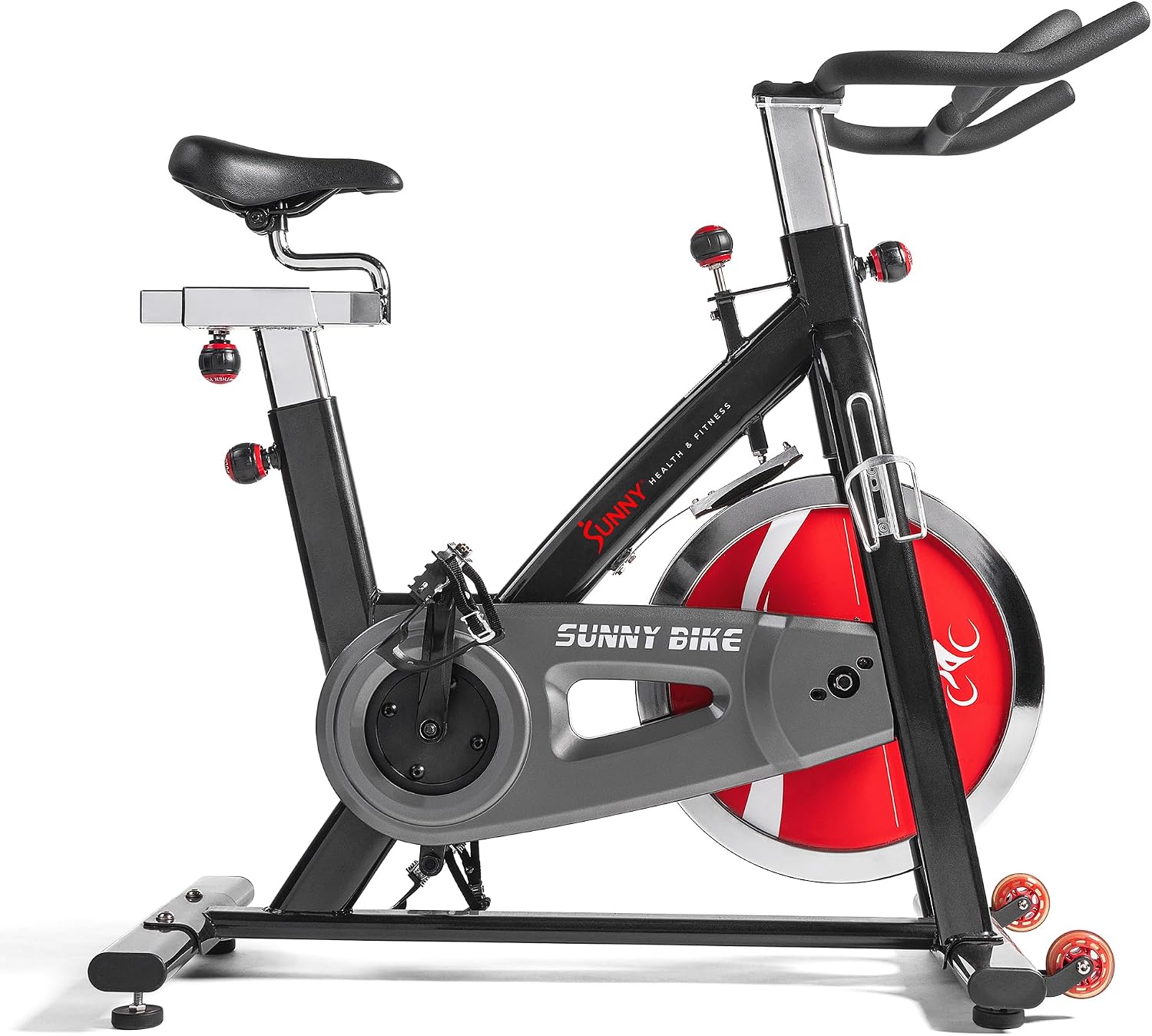
Best Overall: Sunny Health & Fitness Heavy-Duty Indoor Stationary Exercise Bike
The headline here is the flywheel: 49 pounds. In this price band that is a real number, not a sticker. Flywheel weight is marketing until you are standing on the pedals, and then it is physics. A heavier wheel carries momentum through the dead spot at the top and bottom of the stroke, and that is the difference between a pedal stroke that feels round and one that feels like you are stomping on a stair.
The rest of the build points the same direction. The capacity is listed at 275 pounds, the seat adjusts four ways, and the handlebar is a multi-grip design. That last one matters more than people think. A multi-grip bar lets you change hand position when your shoulders start talking to you at minute 30, and it lets you get low and long for a climb instead of gripping one fixed spot for an hour.
Who is this for? The rider who wants one bike in one spot that behaves like a studio bike and never has to be moved. Four-way seat adjustment is the spec I would underline first, because fit is the thing that keeps you riding. My rule has not changed in 14 years: a $300 bike that fits you beats a $1,500 bike that does not.
What to check before you commit is the resistance mechanism. Ask what the pads or magnets are made of and whether replacements are sold separately. Felt pads are fine if the bike is built right, but they do wear, and a bike with no replacement parts is a bike with a shelf life. Also check the pedals. If they come with plastic cages, plan on swapping them, because that is a $30 fix that changes how the whole bike feels.
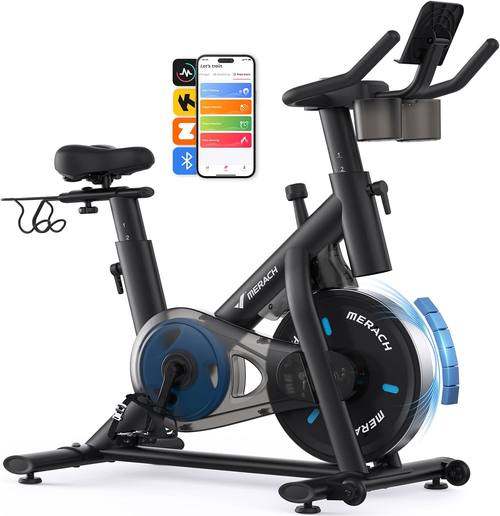
Best Value: MERACH Exercise Bike with APP
This is the magnetic friction upright, and the app is the hook. Magnetic resistance is smoother than felt pads across the range, and it does not wear out the way a pad does, which is the single biggest reason I point budget buyers toward magnets when the price allows it. Smoother resistance across the whole dial is the thing that makes a 45-minute ride feel like 45 minutes instead of a fight.
The app piece is where I want you to be clear-eyed. An app is a nice thing to have. It is not a reason to buy a bike, because the app is the part of the package that can change, move behind a subscription, or quietly stop being supported. Buy the hardware for the hardware. If the app turns out to be good, that is a bonus you keep.
For a rider who wants a quieter, smoother ride and does not want to think about replacing pads in year two, this is the pick. Magnetic resistance also tends to mean less maintenance, and less maintenance means you ride more. That is not a small thing. The most common reason a home bike dies is not a broken part, it is neglect.
The thing I would verify is the seat. The seat is the first thing to replace on 90 percent of budget bikes, so factor it into the price before you decide. A seat that feels like a brick at mile 20 is the reason a lot of these bikes end up as clothes racks by February.
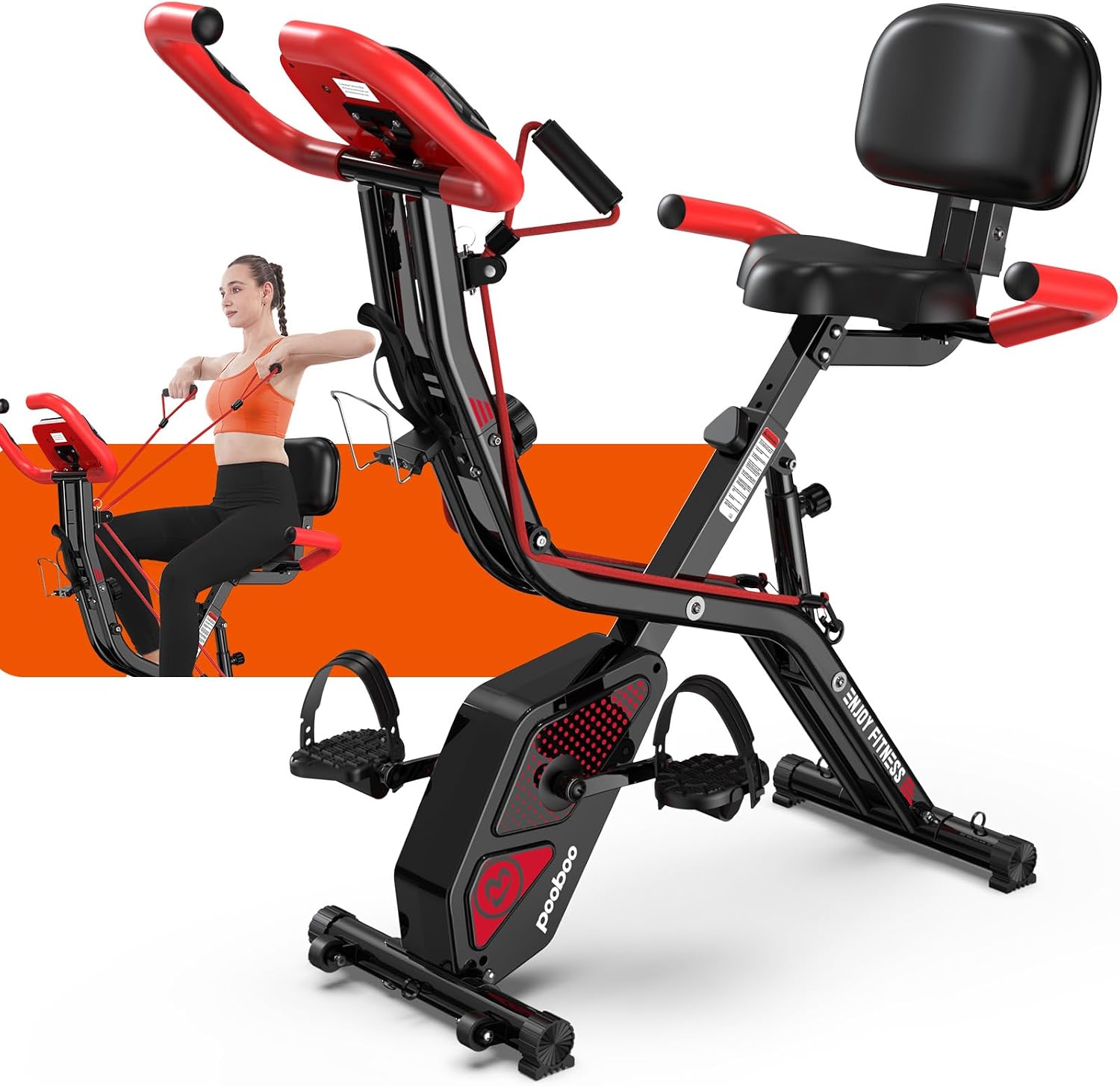
Best for Small Spaces: pooboo Folding Magnetic X-Bike
Folding is the whole pitch, and it is a real one if your space is a corner of a living room rather than a garage. This is an upright with magnetic resistance that folds down, which means it can live against a wall and come out when you ride instead of owning a permanent square of floor. For a lot of people, that is the difference between owning a bike and not owning one.
Here is the trade, and I will not soften it. Folding frames introduce a joint, and a joint is the first place a budget bike gets loose. A wobbly bike at sprint resistance is a safety hazard, not an inconvenience. So if you buy folding, you check the hinge and the locking mechanism every couple of weeks, and you tighten what needs tightening before it becomes a noise, then a wobble, then a problem. That is a five-minute habit, and it is the price of admission.
For a rider in a small apartment who needs the bike to disappear, this is the one of the four that solves the actual problem. Go in knowing you are trading some rigidity for the ability to reclaim your floor. Magnetic resistance keeps it quiet, which matters when the neighbors share a wall.
Best for Desk Days: Sunny Health & Fitness Smart Mini Cycle
This is not a spin bike and I am not going to pretend it is. It is an under desk pedal exerciser for arms or legs, and it does one job: it keeps you moving on the days when you are not going to get on a bike at all.
I have riders who work from home and sit for nine hours. A mini cycle under the desk is not training. It is circulation, it is a nudge, and for some people it is the difference between a day with movement and a day without. As a warm up before a real ride it is also genuinely useful, because it gets blood into the legs without loading them first.
Do not buy this expecting it to replace the Sunny upright above. Buy it if the honest answer to "will I ride a full bike today" is no, because a small yes beats a big no every time.
How I test a budget bike
Every bike I write about gets the same protocol, and it is the protocol I would run on any of these four.
Fifty miles a week for the first stretch, ridden the way my classes ride: seated climbs, standing sprints at full resistance, and long steady efforts where the only thing you notice is whether the bike is still quiet. The standing sprint is the test that separates bikes. A bike can feel perfectly solid for 40 minutes and then wobble the moment you unweight the saddle and drive through the pedals.
The sweat test is literal. Forty-five minutes at max effort, then I look at the frame. Cheap paint and cheap hardware fail this test. If you are buying any bike in this range, wipe the frame down after every ride, because sweat is what kills the finish first and the bolts second.
The bearing check comes at month three. That is when a budget bike tells you the truth. Pedal bearings, bottom bracket, flywheel bearings. If there is a grind, a click, or a rumble, you will hear it by then, and you will know whether the bike has a future.
And the seat. I have replaced more seats than I can count. Budget seats are built to a price, and the price is your comfort. Set aside money for a replacement seat and a set of pedals without plastic cages. That is the upgrade that makes a cheap bike feel expensive.
The comparison table
This is how the four line up. Read the "best for" column first, because the best bike is the one that matches your room and your habit, not the one with the biggest number on the spec sheet.
| Bike | Resistance | Best for | What to know | Price |
|---|---|---|---|---|
 Visit on Amazon → Sunny Health & Fitness Heavy-Duty Indoor Stationary Exercise Bike |
Flywheel-driven, 49 LB flywheel | A permanent studio-style setup | 275 LB capacity, 4-way adjustable seat, multi-grip handlebar | Check current Amazon price |
 Visit on Amazon → MERACH Exercise Bike with APP |
Magnetic friction | Smooth and quiet without pad maintenance | The app is a bonus, not the reason to buy | $269.99 |
 Visit on Amazon → pooboo Folding Magnetic X-Bike |
Magnetic | Small spaces and shared rooms | Check the fold joint every couple of weeks | $114.99 |
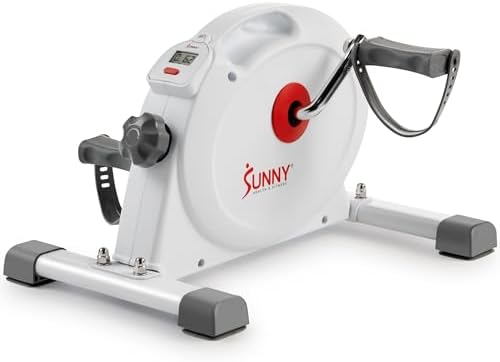 Visit on Amazon → Sunny Health & Fitness Smart Mini Cycle |
Under desk pedal exerciser | Desk workers and warm ups | Arms or legs, and not a replacement for a bike | $69.99 |
What actually matters, and what does not
Resistance type comes first. Magnetic resistance is smoother than felt pads and it does not wear out, so if the budget stretches, stretch it. But felt pads are fine if the bike is built right. The real failure mode is not felt, it is a plastic resistance knob that slips mid-ride. A slipping knob will make you hate a bike that is otherwise perfectly good, and it is the single most common complaint I hear from riders who bought cheap.
Flywheel weight comes second. A heavy flywheel smooths the stroke. A 49 pound flywheel in this price band is the standout number of the group, and it is the reason the Sunny upright is my overall pick. Light flywheels are not automatically bad, they are just less forgiving, and you feel the difference in the first ten minutes of a climb when your legs are fresh and the wheel is not helping.
Q-factor comes third, and it is the spec nobody publishes. Q-factor is the width between your pedals. Too wide and your knees complain after 20 minutes, and no amount of seat adjustment fixes it. If you have knee history, this is worth asking about before you buy anything, and it is worth walking away over.
Comfort comes fourth, and it is not the least important. A bike you do not want to sit on is a bike you will not ride. Comfort beats specs every time. That is not a soft opinion, it is the reason half the bikes sold in this price band get used for three weeks and then leaned against a wall with a laundry basket on the handlebars.
Should you buy the Sunny Health & Fitness Heavy-Duty Indoor Stationary Exercise Bike?
If you have a permanent spot and you want the closest thing in this group to a studio bike, yes. The 49 LB flywheel, the 275 LB capacity, and the four-way adjustable seat are the specs that matter, and they are the specs that keep riders riding. It is the pick for someone who will use it four or five times a week and wants the bike to feel the same in month six as it did in week one.
Should you buy the MERACH Exercise Bike with APP?
Yes, for the rider who wants magnetic resistance and a smoother, quieter ride without thinking about pad replacement. Treat the app as a bonus. Buy it for the hardware, because the hardware is the part that stays with you.
Should you buy the pooboo Folding Magnetic X-Bike?
Yes, if floor space is the thing currently stopping you from riding. Folding solves a real problem for apartment riders, and magnetic resistance keeps it quiet for the people on the other side of the wall. Just accept the maintenance that comes with a hinge, and check it on a schedule.
Should you buy the Sunny Health & Fitness Smart Mini Cycle?
Yes, if the honest answer to "will I ride today" is no. It is not a spin bike and it will not build the legs a spin bike builds. It is the thing that keeps you moving on the days when the full-size bike stays parked, and those days are the ones that decide whether you keep the habit at all.