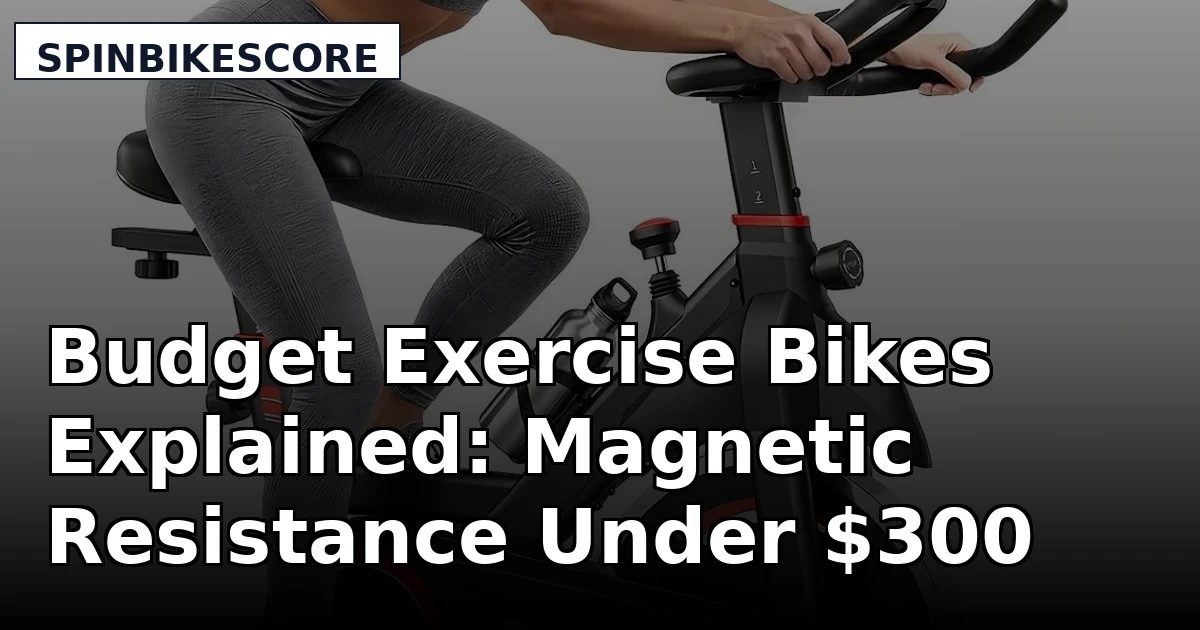
Shopping for budget exercise bikes under $300 is a strange exercise in patience. Every listing uses the same vocabulary: smooth, quiet, sturdy, easy assembly. The photos are nearly identical, the frames are nearly identical, and the differences that decide whether you actually ride the thing are buried in a spec table nobody reads. After enough years teaching indoor cycling, I can tell you the gap between a bike you keep and a bike you drape laundry on comes down to four things: the resistance mechanism, the stated weight capacity, the number of resistance levels, and how much the bike adjusts to your body. Get those right and a cheap bike can carry years of riding. Get them wrong and no amount of "premium" language saves it.
Related: How to Set Up an Exercise Bike for Your Height →
Quick answer
Magnetic resistance is the feature worth prioritizing in this price band, because there is no felt pad to wear down and the resistance feel stays consistent across the range. Among these four listings, the MERACH Exercise Bike states the highest weight capacity at 330 lbs, the Superun Exercise Bike states the widest resistance range at 32 levels, and the two NEWBULIG Exercise Bike listings describe the same model with app connectivity, adjustable height and resistance, a 265 lb capacity, and easy assembly. Which one fits you depends on your body, your ceiling for assembly patience, and whether you want an app guiding the ride.
Four useful options
| Model | Best fit | What stands out |
|---|---|---|
| MERACH Exercise Bike, Magnetic Resistance, 330lbs Capacity | Households sharing one bike, heavier riders | Magnetic resistance plus the highest stated capacity of the four listings |
| Superun Exercise Bike, Stationary Bike with 32-Level Magnetic Resistance | Riders who want fine resistance jumps | 32 stated resistance levels with a magnetic resistance system |
| NEWBULIG Exercise Bike with APP (265 lb, listing one) | Riders who want guided workouts | App connectivity, adjustable height and resistance, 265 lb stated capacity |
| NEWBULIG Exercise Bike with APP (265 lb, listing two) | Same rider profile, different listing | Same described model and features on a separate listing |
The higher-capacity pick: MERACH Exercise Bike, Magnetic Resistance, 330lbs Capacity
Weight capacity is not just a number for the warranty department. On a budget frame, capacity tends to track with how much material is in the frame and the stabilizers, and that is what keeps the bike planted when you stand up and push. A bike rated well above your weight has headroom; a bike rated right at your weight has none. The trade-off here is information: the listing name gives you the resistance type and the capacity, but not the flywheel weight or how many resistance levels the knob moves through, so check the full product page before you commit. Budget bikes in this range almost always ship with a seat you will want to replace within a month, so price a replacement saddle into the total.
The widest resistance range: Superun Exercise Bike, Stationary Bike with 32-Level Magnetic Resistance
Thirty-two levels sounds like marketing padding until you have ridden a bike with eight. Coarse resistance jumps are the reason riders either spin too easy or grind too hard, and the middle of the range is where most of your training actually happens. More levels means smaller steps between them, which matters if you are doing intervals or if you are coming back from an injury and need to add load slowly. The trade-off is that level count tells you nothing about how hard the top of the range gets, and the listing name does not state a weight capacity, so confirm both on the product page.
The app-connected option: NEWBULIG Exercise Bike with APP (265 lb, listing one)
Two things earn their place here. Adjustable height and resistance is the difference between a bike one person can ride and a bike a household can share, and it is the spec I would check before anything cosmetic. App connectivity is worth real money if it is the reason you get on the bike on a Tuesday night, and worth nothing if you already know how to structure a ride. Be careful with the noise language: "low noise" appears as a product feature in the listing, not as a measured decibel figure, so treat it as a description rather than a guarantee. The 265 lb capacity is the lowest of the four listings here, which matters if you are near that line.
The twin listing: NEWBULIG Exercise Bike with APP (265 lb, listing two)
When the same model shows up twice, do not assume one is a newer revision. Listings for identical models can differ in what ships in the box, in the accessories included, and in availability, and the only reliable way to sort it out is to open both product pages side by side and compare the details rather than the photos. If the described features match, treat the two NEWBULIG listings as one option in your decision and pick based on what each listing currently shows.
Prices and availability may change. Product images, names, and retailer links must be matched by verified ASIN. Do not state a current price, rating, stock status, or measured result without current evidence.
What magnetic resistance actually changes
Resistance is how the bike makes you work, and there are two ways budget bikes do it. Felt pad systems press a pad against the flywheel. They are cheap, they feel fine when new, and they wear. The pad glazes, the resistance at a given knob position drifts, and eventually you are turning the knob further than you did in month one to get the same effort. Magnetic systems move magnets closer to or further from the flywheel. Nothing rubs, so nothing wears, and the resistance at a given setting stays where you left it. That is the whole argument, and it is a good one.
What magnetic resistance does not automatically give you is a hard ceiling. A magnetic bike with a light flywheel can still feel choppy at high resistance, because the flywheel is what smooths the pedal stroke between your pushes. Magnet strength and flywheel mass are separate variables, and listings rarely tell you both. The practical read: magnetic resistance solves the wear problem, and flywheel weight solves the smoothness problem. If a listing gives you magnetic resistance and stays silent on flywheel weight, you have solved half the equation and should look for the rest on the product page.
The other thing resistance type changes is noise. Felt pads against a spinning flywheel make a friction sound that rises with resistance. Magnets do not. This is why so many magnetic bikes get described as quiet. It is a real advantage, but it is a relative one, and it says nothing about the sound of the drivetrain, the pedals, or the frame under load.
Capacity, adjustability, and the fit numbers that matter
Weight capacity is the number riders skip and then regret skipping. It is not a suggestion about who is allowed on the bike. It is a statement about how much load the frame, the seat post, and the stabilizers are built to carry. The four listings here state 265 lbs, 265 lbs, 330 lbs, and no stated figure at all, and that spread is the single easiest way to narrow the field. If you are anywhere near the top of a stated range, move up rather than assume margin exists.
Adjustability is the second number. A bike with adjustable seat height, seat fore and aft, and handlebar height can be fitted to a wide range of bodies. A bike with only seat height adjustment fits a narrow band, and the riders outside that band end up with sore knees or numb hands and quietly stop riding. Seat height should let your knee stay slightly bent at the bottom of the stroke. If the bike cannot get there, nothing else about it matters.
Then there is the seat itself. Budget bikes ship with budget saddles, and a saddle that hurts at mile twenty is the most common reason a home bike goes unused. Assume you will replace it. A replacement saddle costs less than a month of studio classes, and it is the highest-return upgrade on any bike in this price band. Same logic for pedals: if the bike arrives with plastic cages, and you plan to ride in cycling shoes, check whether the pedals can be swapped before you buy.
Finally, look at the resistance knob material. A plastic knob on a metal stem is where cheap bikes fail first, and a knob that slips mid-ride is both annoying and, at sprint resistance, a stability problem. It is a small detail that tells you a lot about the rest of the build.
How to choose in five steps
- Write down your actual body weight and add a margin, then eliminate any listing whose stated capacity sits below that number.
- Confirm the resistance type is magnetic if you plan to ride more than twice a week, since pads wear faster with daily use.
- Check how many resistance levels the bike offers and whether the jumps between them are small enough for the way you train.
- Verify the adjustability range, seat height, seat fore and aft, and handlebar height, against your own measurements.
- Budget for a replacement saddle and, if needed, replacement pedals, then compare the total against the alternatives.
Practical guidance before you buy
- Measure your inseam and your ceiling height before ordering, because a bike that fits your body can still be too tall for the room.
- Read the assembly instructions in the listing photos if they are shown, and set aside a realistic block of time rather than assuming a fifteen minute build.
- Check the return window and whether the bike ships in one box, since a return on a heavy item is a project of its own.
- Treat noise claims as descriptions unless the listing gives a measured figure, and remember that drivetrain and pedal noise are separate from resistance noise.
- Plan the first month as a fit experiment: adjust, ride, adjust again, and only then decide whether the saddle needs replacing.
- Keep a wrench set within reach. Every home bike needs a re-torque on the pedals and the seat clamp after the first few rides.
Which option should you choose?
Choose the MERACH Exercise Bike, Magnetic Resistance, 330lbs Capacity when capacity and a shared household are the priority, since it states the highest weight limit of the four listings. Choose the Superun Exercise Bike, Stationary Bike with 32-Level Magnetic Resistance when you want the finest resistance steps and train in intervals. Choose either NEWBULIG Exercise Bike with APP listing when app-guided rides and adjustable height and resistance matter more to you than a higher stated capacity. If you land on the NEWBULIG model, compare the two listings directly, because they describe the same bike.
One caveat worth stating plainly: the details above come from the product listings, not from a full test. I have not put these four bikes through a long-term ride, so treat capacity, level counts, and noise language as the manufacturers' descriptions, and confirm anything that would change your decision on the current product page.
The bottom line
The differences among budget exercise bikes in this price range are not about brand prestige. They are about whether the resistance wears out, whether the frame is rated for you, whether the bike can be fitted to your body, and whether the seat is something you can live with. Magnetic resistance plus an honest capacity figure plus a wide adjustment range is the formula, and every one of these four listings gets part of it right. Match the bike to your body and your training, replace the saddle, and re-torque the bolts, and a sub-$300 bike will hold up longer than most riders expect.