Shopping for magnetic exercise bikes for home gets confusing fast because every listing leads with the same three words: smooth, quiet, comfortable. None of those words survive a standing sprint at full resistance, and none of them tell you whether the frame will still feel planted in month three. After fourteen years of teaching indoor cycling, I can tell you the decision really comes down to three things: how the bike holds you when you stand up, how the resistance feels from easy to hard, and whether the saddle is something you can sit on for 45 minutes. Everything else, including the app and the tablet mount, sits on top of those three.
Related: How to Set Up a Spin Bike for Your Height and Reach →
Quick answer
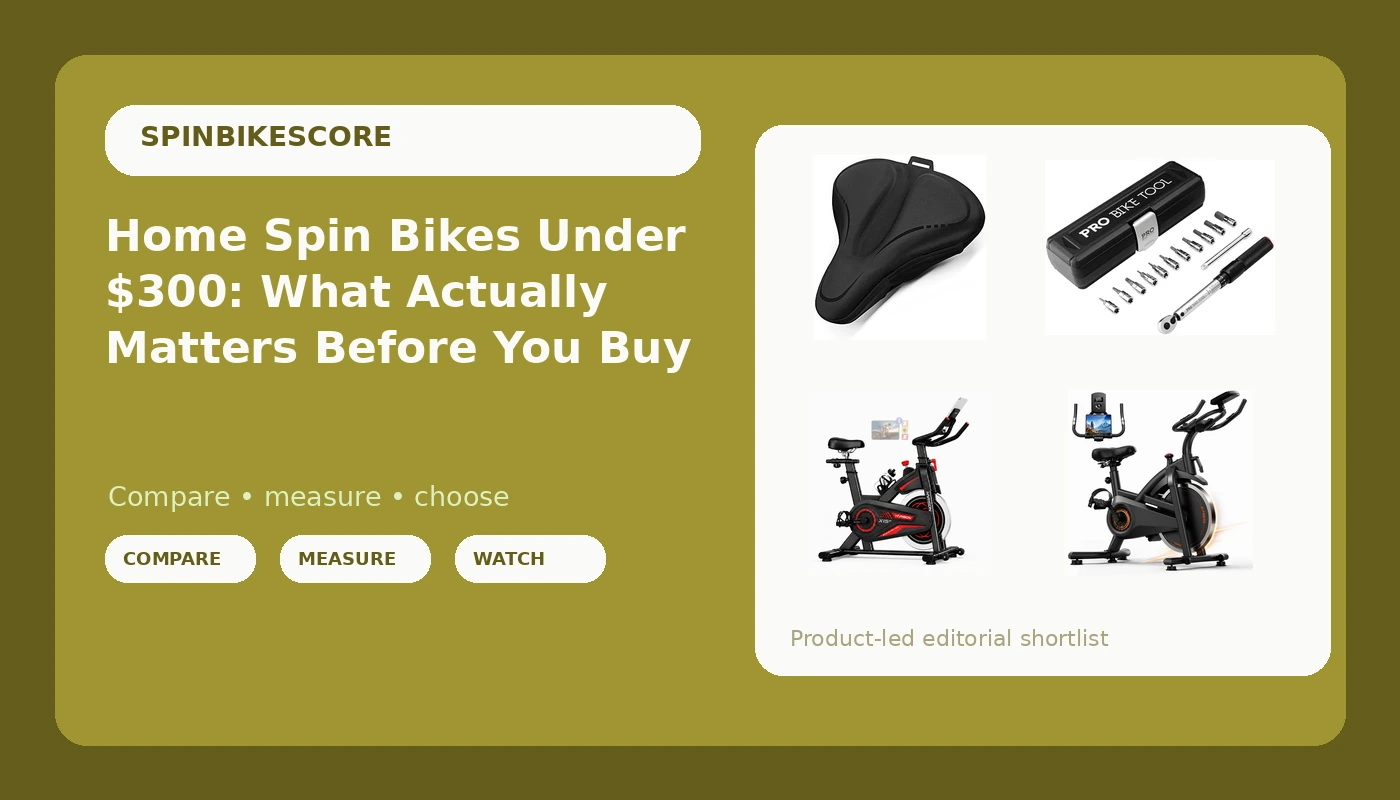
Match the bike to your body and your space first, then budget for the two parts budget bikes get wrong most often: the seat and the hardware. If you want a bike with a stated 350 lb weight capacity, a tablet mount, and app connectivity, the HARISON is the one to look at. If you want the lowest-cost way to start pedaling indoors, the CURSOR is the entry point. If your current bike is fine but your sit bones disagree with it, the ANZOME seat cushion is the inexpensive fix. And if you are assembling or maintaining any of it, the PRO BIKE TOOL torque wrench set is the tool that keeps bolts from loosening and creaking over time.
Four useful options
| Model | Best fit | What stands out |
|---|---|---|
| HARISON Exercise Bike | Riders who want a stated 350 lb capacity and app connectivity | Magnetic workout bike with Bluetooth app, tablet mount, brake pad, and a comfort seat cushion |
| CURSOR Exercise Bike | Small spaces and the lowest-cost entry into indoor riding | Magnetic friction resistance with an app-based ride option |
| ANZOME Bike Seat Cushion | Anyone whose stock saddle hurts before mile 20 | Wide foam and extra soft gel padding sized for saddles 8.5 to 10 inches wide, with a rain cover included |
| PRO BIKE TOOL Bike Torque Wrench Set | Assembly and monthly bolt checks | 1/4 inch drive with a 2.2 to 16.9 Nm range for small fasteners |
The all-rounder: HARISON Exercise Bike
Weight capacity is the spec people skip and then regret. A bike rated for a lighter rider will flex at the seat post under a heavier one, and flex at the seat post turns into a wobble at the handlebars once you stand up. The HARISON also bundles the two accessories that usually cost extra: a tablet mount and a padded seat. That matters because the seat is the first thing most riders replace, so a bike that ships with a cushioned saddle starts you further ahead. The trade-off is that a bike with this many features at this price point will not have the flywheel mass of a studio machine, so expect a slightly less glassy pedal stroke than you would feel on a commercial bike.
The light entry point: CURSOR Exercise Bike
Here is the honest case for an entry bike: the best bike is the one you will actually sit on three times a week. A rider who spends $250 and rides 100 times beats a rider who spends $1,200 and rides four times, and that is not a motivational slogan, it is just arithmetic. What you give up at this level is refinement. Magnetic friction resistance is smoother than felt pads and does not wear out the way pads do, but the resistance range tends to be narrower, so the jump between easy and hard can feel abrupt. Check the seat post and the handlebar post for play before your first ride, and re-check them after a week. Loose posts are the number one source of the wobble people blame on the frame.
The comfort upgrade: ANZOME Bike Seat Cushion
I tell every new rider the same thing: give a stock saddle three rides before you judge it, because some of the discomfort at mile three is just your body adapting. After three rides, if the pressure is still there, change something. A gel and foam cushion is the cheapest intervention, and it is far cheaper than replacing a bike you otherwise like. The catch is fit. Measure your saddle before you buy, because a cushion that is too wide will rub the inside of your thighs on every pedal stroke, and that is worse than the original problem. Also understand what a cushion can and cannot do: it spreads pressure across a wider area, but it does not change your saddle height, your reach, or your hip angle. If your knees ache rather than your sit bones, the cushion is not the fix, your bike fit is.
The setup tool: PRO BIKE TOOL Bike Torque Wrench Set
This is the least exciting item on the list and the one that quietly prevents the most problems. Two failure modes wreck home bikes. The first is under-tightening: bolts that were snug in January work loose by March, and a seat post that shifts mid-ride is a genuine safety issue, not an annoyance. The second is over-tightening: cranking a seat clamp or handlebar bolt until it feels secure can crush the clamp or strip the threads, and that is a permanent repair. A torque wrench removes the guesswork from both. It is also the tool you will use on the second bike, the third bike, and the pedals you swap between them, which is why I keep one by the door.
Prices and availability may change. Product images, names, and retailer links are matched to verified listings. No current price, rating, stock status, or measured result is stated here without current evidence.
Why resistance type and flywheel mass change the ride
Magnetic resistance uses magnets moving closer to or further from the flywheel to change difficulty. Because nothing touches, there is no pad to wear down and no friction dust, and the resistance tends to hold steady at a given setting. Magnetic friction, the system in the CURSOR, is a variation on the same idea. Felt pad resistance is the older approach: a pad presses against the flywheel. It works, and plenty of riders use it happily, but the pad wears, the resistance drifts as it does, and you replace pads over time.
Flywheel mass is the other spec worth understanding. A heavier flywheel carries more momentum, which smooths the dead spots in your pedal stroke and makes the transition from downstroke to upstroke feel continuous rather than choppy. The catch is that a heavy flywheel also takes longer to slow down and is harder to accelerate from a standing start. For steady endurance riding, more mass feels better. For short, punchy intervals with constant resistance changes, a lighter flywheel can actually respond faster. Neither number wins on its own. What matters is whether the resistance feels controllable across its full range, and that is something you can only judge by sitting on the bike and turning the knob through its travel.
Seat, pedals, and the parts that fail first
- Sit on the bike at the resistance you plan to ride at, then stand up and pedal. A bike that shifts or rocks under you is not the right frame for your body.
- Turn the resistance knob from the easiest setting to the hardest and back. It should feel smooth and predictable, with no slip and no sudden jump at the top end.
- Measure your current saddle before ordering a cushion, since a cushion sized for a different saddle width will rub rather than help.
- Check whether the pedals accept the shoes or clips you already own, because plastic cages are a common weak point and swapping pedals is an extra cost.
- Plan a bolt check at week one, month one, and month three. Most of what people call a quality problem is a fastener that needed a torque spec.
Practical guidance for a small home setup
- Put the bike on a hard, level surface. Carpet under a bike that has any flex will amplify movement you would not notice on a floor.
- Leave a mat under the bike, but keep the mat thin. A thick, squishy mat is the opposite of stability.
- Set saddle height first, then reach, then handlebar height. Changing all three at once makes it impossible to know what fixed the discomfort.
- Keep a torque wrench and the correct hex keys together in one place. The tool you have to hunt for is the tool you will not use.
- Treat the seat as a consumable, not a permanent part. If a saddle does not work for you, changing it is normal, not a sign you bought the wrong bike.
- Re-check the seat clamp and pedal threads after your first long ride. That is when new hardware settles.
Which option should you choose?
Choose the HARISON Exercise Bike when you want a stated 350 lb weight capacity, app connectivity, and a tablet mount in a single purchase and you would rather not buy accessories separately. Choose the CURSOR Exercise Bike when you are new to indoor riding, working with a tight budget, or short on floor space and you want to test the habit before you invest in it. Choose the ANZOME Bike Seat Cushion when the bike you already own is mechanically fine but uncomfortable, and you have measured your saddle to confirm the 8.5 to 10 inch fit. Choose the PRO BIKE TOOL Bike Torque Wrench Set when you are assembling a new bike or maintaining an older one, since the 2.2 to 16.9 Nm range covers the small fasteners that loosen first.
One caveat worth stating plainly: capacity, resistance range, and saddle comfort are personal. A bike that fits a 5 foot 4 rider may not fit a 6 foot 2 rider, and no listing can tell you which one you are. Where a spec is not stated on the listing, treat it as unknown rather than assuming it.
The bottom line
The gap between cheap home bikes and mid-priced ones has narrowed, mostly because the mid-priced tier stopped improving rather than because the cheap tier caught up. That makes the decision simpler than the listings suggest. Pick the frame that fits your body and stays planted when you stand, accept that the saddle is probably a project rather than a finished feature, and own the tool that keeps the bolts where you put them. Two bikes at different price points, one cushion, and one torque wrench cover almost every version of this problem, and none of them requires you to believe a marketing claim about smoothness.