I've taught indoor cycling for 14 years, and every November the same thing happens in my garage. Someone hauls home a budget bike, rides it four times, and by February it's a laundry rack with handlebars. It is almost never the rider's fault. It's a bike that wobbles the second they stand up, or a saddle that turns a 30-minute ride into a countdown clock. So when I line up budget exercise bikes for home, I don't sort them by the feature list on the box. I ask which one a real rider is still sitting on in March.
If I were buying one of these four for a small apartment, I'd take the folding bike with 16 levels of magnetic resistance and a 300-pound capacity, because magnetic resistance doesn't wear out and the fold means it survives a hallway closet. If floor space isn't the issue and you want the simplest machine to keep alive, the upright with the brake pad is the honest, serviceable choice.
That's the short version. Here's the table, then the reasoning behind it.
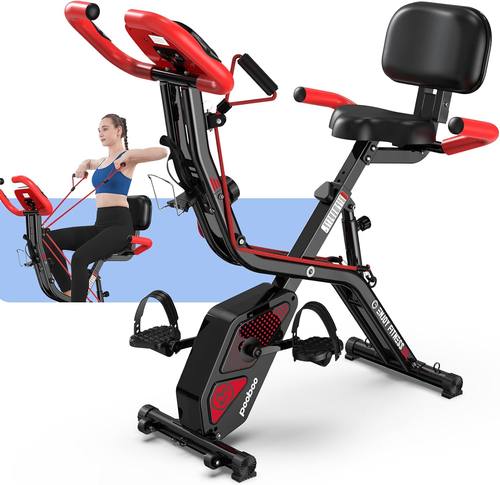
CURSOR FITNESS Exercise Bike, Stationary Bikes for Home with Brake Pad
Plain upright frame with no hinge in the load path, and brake pad resistance you can adjust or replace yourself with a wrench
Felt pads compress and glaze over time, so resistance range shrinks unless you maintain it, and there is no fold when space is tight
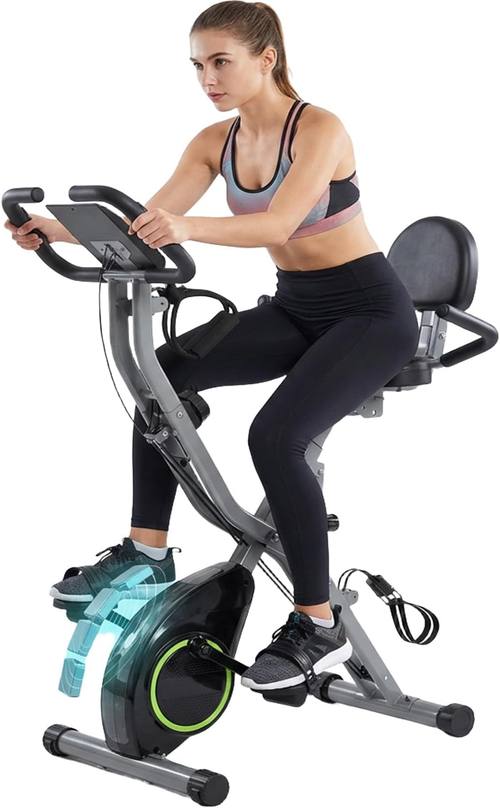
Foldable Exercise Bike Stationary Bikes for Home, 5 IN 1 Indoor Workout Bike, with 16-Level Quiet Magnetic Resistance, 6.6 LBS Flywheel and 300LBS Capacity
Documented resistance spec with 16 magnetic levels that don't fade, a 300-pound capacity rating, and 5-in-1 positioning that folds away
A 6.6-pound flywheel is light, so standing sprints will feel less smooth than a studio bike, and the folding hinge is a flex point to check monthly
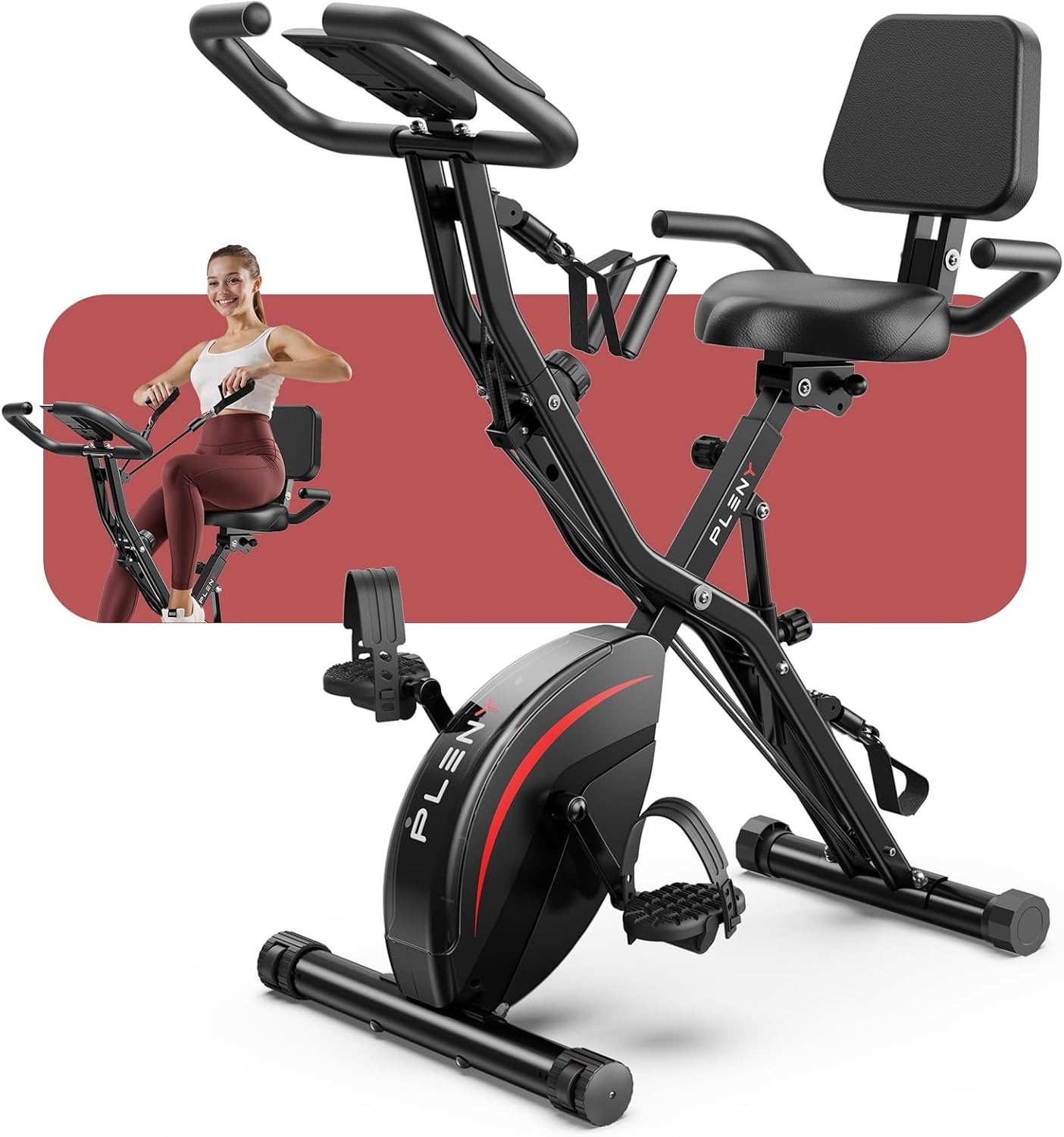
PLENY Folding Exercise Bike, 5 IN 1 Indoor Stationary Bikes for Home
Same folding 5-in-1 format, so it disappears into a closet and gives you multiple seating positions
The listing I have doesn't break out resistance levels, flywheel weight, or a capacity rating, so you're buying the format without the numbers pinned down
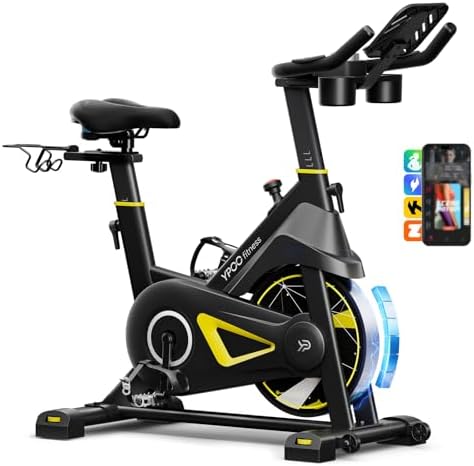
YPOO Exercise Bike Adjustable Magnetic Resistance 330LBS, APP Courses
Highest capacity rating here at 330 pounds, adjustable magnetic resistance that stays smooth, and app courses to keep you riding
App courses raise the question of subscriptions and whether the bike reports cadence and resistance to the app, so ask before you buy
Prices and availability were captured from Amazon Creators API and may change.
What I check before I recommend any budget bike
Four things, in this order.
- Does it stay planted when you stand up at high resistance? A bike that walks across the floor at sprint speed is a safety problem, not an annoyance.
- Is the resistance smooth from easy to hard, or does it jump in steps?
- Will the seat and pedals survive month three? The saddle is the first thing to go on almost every budget bike.
- Does it fit a range of riders? If the seat post and handlebars don't move enough for a 5'2" rider and a 6'2" rider, half the household is locked out.
I keep a wrench set by the door because every bike in my garage has needed it, and I have never met a budget bike that arrived with every bolt at the right torque. Two of the four bikes here also fold, which adds a hinge to that checklist. Hinges need checking monthly, and a loose hinge is the difference between a stable ride and a bike that clunks when you push.
The two folding bikes: 16 resistance levels versus a plain 5-in-1
The Foldable Exercise Bike with the 16-level magnetic resistance system is the more specific of the two folders. The listing spells out a 6.6-pound flywheel, a 300-pound capacity, and the 5-in-1 positioning that lets you use it as an upright, a semi-recumbent, and a few other configurations.
That 6.6-pound flywheel number is the one I'd sit with. Flywheel weight is marketing until you're standing on the pedals, and then it's physics. A 6.6-pound wheel is light by studio standards, and a light wheel means a pedal stroke that feels less like a smooth circle and more like a series of pushes. That's not a dealbreaker at this price, and it matters less if you ride seated at moderate resistance. It matters a lot if you plan to stand and sprint, because a light flywheel plus a folding hinge is the exact combination that gets wobbly. Magnetic resistance is the compensation here, since magnets don't fade the way a pad does, so the resistance you feel on day one is the resistance you feel in year two.
The PLENY Folding Exercise Bike is the other folder, and it's also a 5-in-1. The record I have for it doesn't break out resistance levels, flywheel weight, or a capacity rating the way the other listing does, so if those numbers matter to you, get them from the seller before you commit. What I can tell you is that the 5-in-1 format is a real benefit for anyone in a small space and a real liability for anyone who wants a bike that feels planted. Every folding frame has a hinge, and every hinge is a place where a little movement shows up under load.
If you're choosing between these two folders, the deciding question is whether you want the resistance spec pinned down. One of them tells you exactly what you're getting: 16 levels, magnetic, 6.6-pound wheel, 300-pound capacity. The other asks you to trust the format and confirm the details yourself.
The upright with a brake pad: simple, serviceable, and it will need you
The CURSOR FITNESS bike takes the oldest approach in the room. A brake pad pressing on a flywheel is how spin bikes worked for decades, and it still works. There's no control board, no magnets, and no electronics to fail.
Here's my honest position on felt pads: magnetic resistance is smoother and quieter, but a felt pad is fine if the bike is built right. The catch is maintenance. Pads compress, glaze, and wear, and when they do, your resistance range shrinks. You notice it as a knob that has to turn further and further to give you the same effort. Replacing a pad is a cheap fix and a ten-minute job, but it is a job, and it's the kind of job people skip.
The upside of this bike is that the frame is a plain upright with no hinge in the load path, so the money goes into the parts that hold you up rather than into a folding mechanism. For a rider who wants one machine in one spot and doesn't need it to disappear into a closet, that trade is usually the right one.
The magnetic upright with app courses
The YPOO Exercise Bike is the outlier in this group. It pairs adjustable magnetic resistance with a 330-pound capacity and app-based courses.
Two things stand out. First, the 330-pound capacity is the highest rating here, and capacity ratings usually correlate with a sturdier frame, which is the spec that matters most for standing work. Second, the app courses are worth thinking about carefully. Guided classes are what keep most people riding, and that isn't a small thing. What I'd want to know before buying is whether the courses require a subscription, whether the bike reports cadence and resistance to the app, and what happens to the bike if the app goes away. The hardware should stand on its own, because apps come and go and a bike should outlive them.
Magnetic resistance is the right call here. It's smooth across the range and it doesn't wear, so the resistance you feel in month one is the resistance you feel in year two. If quiet matters in your house, magnetic is the mechanism to pick, and this is the bike in this group that leans hardest into that.
The trade-offs nobody puts on the box
Folding versus upright. Folding bikes exist because floor space is real. The cost is a hinge, and a hinge under a rider at sprint resistance is a flex point. If your bike will live in the same spot forever, buy upright and spend the folding premium on a better seat.
Magnetic versus felt. Magnetic wins on smoothness, noise, and longevity. Felt wins on simplicity and serviceability. Neither is a scam, but only one of them quietly loses resistance range over two years.
Capacity ratings. Treat them as a floor, not a ceiling. A 300-pound rating on a folding frame and a 300-pound rating on a welded upright are not the same claim, and the number alone doesn't tell you which one you're getting.
The seat. The seat is the first thing to replace on 90% of budget bikes, and I'd factor the cost of a decent replacement saddle into the purchase. A bike you don't want to sit on is a bike you won't ride, and no spec sheet fixes that.
The pedals. Plastic cages on budget pedals are a pet peeve of mine. If the pedals flex or the cage rattles, swap them for a set with metal cages or clipless compatibility, and check that the crank thread matches before you order.
Q-factor. The width between the pedals matters more than people think. If you're wide through the hips, a narrow Q-factor will have your knees complaining after 20 minutes. If you're narrow, a wide one will do the same. It's one of the few fit dimensions you can't adjust after the fact.
Who each bike is for
- Small apartment, one rider, needs the bike out of the way: the folding bike with the 16-level magnetic resistance and the 300-pound capacity, because the resistance spec is documented and the fold is the entire point.
- Same small space, but you want the 5-in-1 positions and you're willing to ask the seller for the numbers: the PLENY folder.
- A dedicated corner in a garage or spare room, and you want a machine you can service yourself with a wrench: the CURSOR FITNESS upright with the brake pad.
- A rider who wants guided classes and a higher weight capacity, and who will actually use the app: the YPOO magnetic upright.
What I'd do before the first ride
- Check every bolt with a torque wrench, especially the hinge on a folder and the seat clamp.
- Level the bike. A wobbly bike is often just a bike on an uneven floor, and a rubber mat fixes most of it.
- Ride ten minutes seated and ten minutes standing at the resistance you actually plan to use. That's when you find out whether it walks.
- Swap the seat if it feels like a brick at mile 20. It will.
- Put the wrench somewhere you'll find it. Every budget bike in my garage has needed a re-tension somewhere in month one, and the ones that got it are the ones still being ridden.
The bottom line
None of these four bikes is a commercial studio bike, and none of them pretends to be. What separates them is the resistance mechanism and the frame. Magnetic resistance on a frame without a hinge is the combination that ages best, which is why the folding bike with the 16-level magnetic system and the YPOO upright are the two I'd look at first. If your priority is a machine you can adjust with a wrench and never think about electronics, the brake pad upright is the one that will still be working when the app is gone.
Pick the one that fits your room and your body, ride it 50 miles before you judge it, and replace the seat. That's the whole guide.