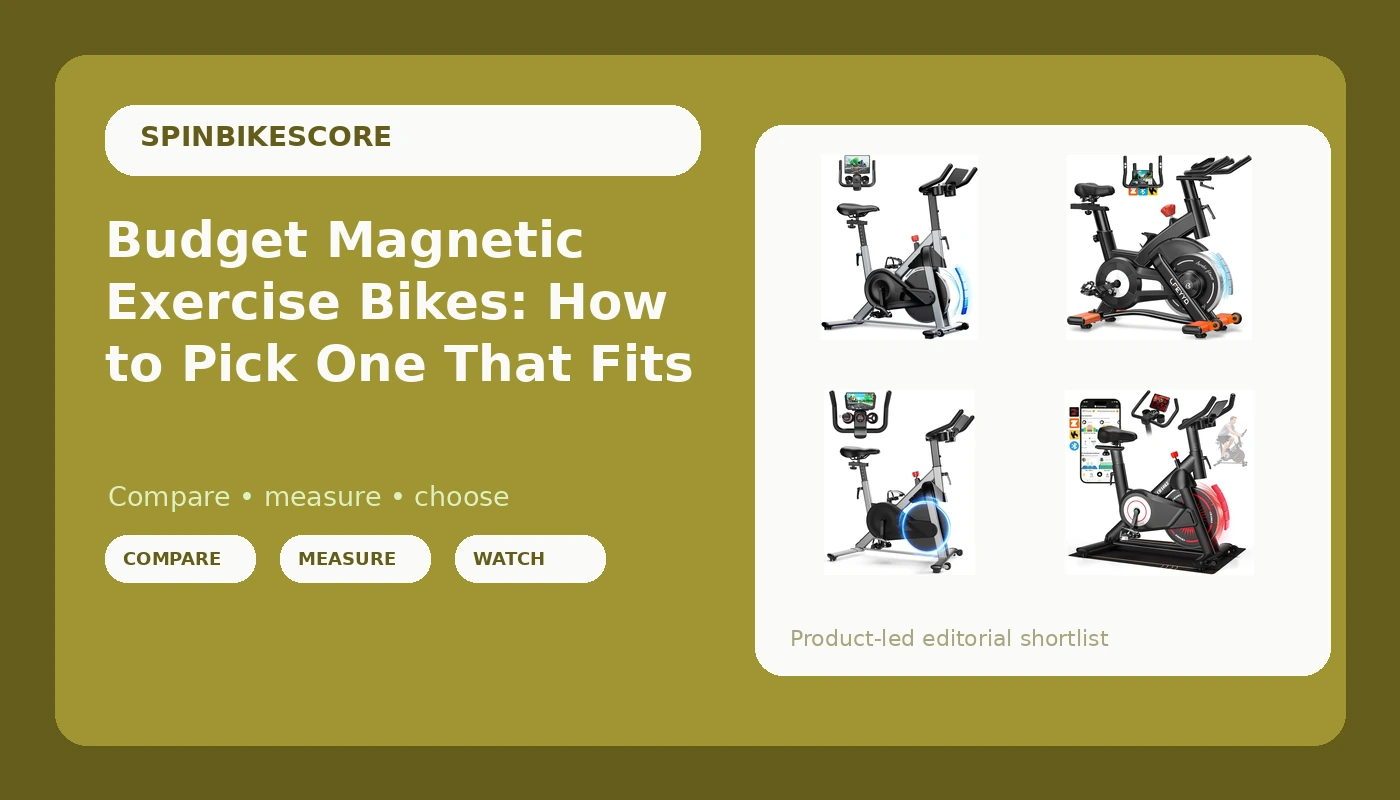
Shopping for budget magnetic exercise bikes is mostly an exercise in reading spec sheets carefully, because the four bikes below look nearly identical in a search results grid and are not identical at all. They differ in the things that decide whether you keep riding in month three: how many resistance steps you get, how much rider weight the frame is rated for, and whether the seat and handlebars move enough to fit your body. Nobody can feel those differences through a product photo. You have to read the numbers, decide which ones matter for your body and your goals, and then pick the bike whose numbers match. That is the whole method, and it takes about ten minutes.
Related: How to Set Up a Spin Bike for Your Height and Reach →
Quick answer
Match the bike to your body before you match it to your budget. If you want the widest listed resistance range at the lowest listed cost, start with the Superun. If seat adjustability is your priority, the MJWW lists a fully adjustable seat along with a 300 lb capacity. If you want the highest listed weight capacity in this group, the 400 lb Magnetic Stationary Bike is the one to look at. If you want a digital display and a 350 lb rating in the middle of the range, the CHAOKE fits. Two of these list app connectivity, which is not the same thing as a built-in class subscription, so do not buy expecting a Peloton-style ecosystem.
Four useful options
| Model | Best fit | What stands out |
|---|---|---|
| Superun Exercise Bike, Stationary Bike with 32-Level Magnetic Resistance | Riders who want the most resistance steps at the lowest listed cost | 32 listed levels of magnetic resistance |
| MJWW Magnetic Exercise Bike with Smart App | Riders who need seat adjustment range | Listed 300 lb capacity, 32-level belt drive, fully adjustable seat |
| CHAOKE Exercise Bike, Quiet Adjustable Magnetic Stationary Bike | Riders who want a digital display and a 350 lb rating | Listed 350 lb capacity, app compatible, digital display |
| Exercise Bike, 400LB Magnetic Stationary Bike with App and Heart Monitor | Heavier riders who need the highest listed capacity here | Listed 400 lb capacity, app connectivity, heart monitor |
The widest resistance range for the money: Superun Exercise Bike, Stationary Bike with 32-Level Magnetic Resistance
The trade-off here is information. A 32-step resistance range is genuinely useful, because it lets you make small jumps between easy spinning and hard efforts instead of lurching from one extreme to the other. What the listing does not advertise is a weight rating, an app, or a heart monitor, and that silence is worth respecting. If you are a heavier rider, confirm the capacity before you order rather than assuming. If you want your phone to talk to the bike, this is not the model that promises it.
The fit-first pick: MJWW Magnetic Exercise Bike with Smart App
Seat adjustment is the least glamorous spec on any bike and the one most likely to decide whether yours becomes a clothes rack. You want the seat to move up and down, and ideally forward and back, so you can set the distance between the saddle and the pedals to match your leg length. The MJWW lists a fully adjustable seat, a 300 lb capacity, and the same 32-level magnetic resistance as the Superun, with a belt drive described as quiet. The app connectivity is a bonus, not a reason to buy, since app pairing usually means you run your own workout rather than getting coached classes included.
The display and capacity middle ground: CHAOKE Exercise Bike, Quiet Adjustable Magnetic Stationary Bike
A console on the bike itself matters more than people expect. If you have to mount a phone or a tablet every time you ride, you will skip rides. If the bike tells you your time and effort on its own, the friction between deciding to ride and actually riding drops. The CHAOKE also sits in the middle of this group on capacity, which makes it the sensible choice for a household where two riders of different sizes share one bike and neither wants to worry about the frame.
The highest listed capacity: Exercise Bike, 400LB Magnetic Stationary Bike with App and Heart Monitor
A heart monitor on the bike is a small feature with an outsized effect on how you train. Riders who can see their heart rate tend to pace themselves instead of going out too hard and burning out in twelve minutes. It is not a substitute for a chest strap if you want real accuracy, but for steady aerobic work it is enough to keep you honest. The 400 lb rating is the headline, and it is the reason this bike costs more than the others here.
Prices and availability may change. Product images, names, and retailer links are matched to verified listings. No current price, rating, stock status, or measured result is stated here without current evidence.
What magnetic resistance actually buys you
Magnetic resistance uses magnets to create braking force against the flywheel instead of pressing felt pads against it. The practical difference is wear. Felt pads are a consumable. They compress, glaze, and eventually stop gripping, and on a bike you ride daily that can happen within months. Magnetic systems do not have a pad to replace, and the resistance tends to feel smoother and more consistent across the range because the force is applied without friction between two surfaces.
The number of resistance levels is a separate question from the mechanism. Thirty-two levels does not mean a bike is twice as hard as a bike with sixteen. It means the steps between the easiest and hardest settings are smaller, which makes it easier to find the exact effort you want and to progress in small increments. For interval work, that matters. For steady riding, it matters less. If you only ever ride at two or three settings, a wide range is a nice-to-have rather than a must.
One caution about the word quiet. Magnetic resistance is quieter than felt pads in principle, but noise also comes from the belt, the bearings, and the frame's willingness to flex. Do not treat "quiet" in a product name as a measurement. Treat it as a design intent.
Reading capacity numbers without getting fooled
Weight capacity is the most consequential number on this page and the easiest to misread. A 300 lb rating is a ceiling, not a target. Riders who sit close to a bike's limit often notice more flex and more wobble, especially when they stand up to pedal, and standing sprint work loads a frame very differently than seated spinning. If you are anywhere near a rating, buy one step above it. The 400 lb bike in this group exists precisely for that reason.
Adjustability is the second number that gets ignored. Seat height range determines whether the bike fits a rider between roughly five feet and six feet four. If two people of very different heights share the bike, the seat post needs enough travel for both, and the handlebars need to move too. Check the listed height range against every rider in your house before you buy, not just yourself.
App connectivity deserves a clear-eyed look. On these bikes it generally means the bike can pair with a phone app, not that classes and coaching are included. If you already have a training app you like, pairing is useful. If you are buying the bike for the classes, you are shopping in the wrong category and the subscription bikes are the ones built for that.
- Measure your inseam and compare it to the listed seat height range before anything else.
- Weigh yourself and everyone who will share the bike, then add a margin and buy above it.
- Decide whether you want a console on the bike or you are happy mounting a phone.
- Decide whether app pairing matters to you or whether it is a feature you will never use.
- Compare resistance level counts last, once fit, capacity, and display are settled.
Practical guidance before you order
- Set a realistic budget that includes a replacement seat, because the stock saddle on most budget bikes is the first thing riders swap.
- Plan on swapping the pedals for a pair with real toe straps or clipless compatibility if you ride hard.
- Check the bike's footprint against the space you actually have, including the ceiling height if you stand to climb.
- Keep a wrench set handy, since assembly and the first month of tightening are part of owning any budget bike.
- Expect to recheck every bolt after the first two weeks, because vibration loosens hardware that felt tight on assembly day.
Which option should you choose?
Choose the Superun Exercise Bike, Stationary Bike with 32-Level Magnetic Resistance when you want the widest resistance range at the lowest listed cost and you do not need a console or app pairing. Choose the MJWW Magnetic Exercise Bike with Smart App when seat adjustability is the deciding factor and a 300 lb rating covers your household. Choose the CHAOKE Exercise Bike, Quiet Adjustable Magnetic Stationary Bike when you want a digital display on the bike and a 350 lb capacity. Choose the Exercise Bike, 400LB Magnetic Stationary Bike with App and Heart Monitor when you need the highest listed capacity here and you want heart rate visible while you ride.
Every recommendation above rests on what each listing states, not on measured performance. No bike here has a published decibel figure, no flywheel weight is given, and no independent stability testing is cited, so treat any claim about smoothness or silence as unproven until you ride one yourself. If you are near a weight rating or you ride standing at high resistance, favor the higher capacity and accept the higher cost.
The bottom line
These four bikes are separated by three things: resistance range, weight capacity, and whether the bike carries its own display. Fit comes first, capacity comes second, and features come third, because a bike that fits and holds you steady will get ridden and a bike that does not will not. Buy the one whose listed numbers match your body and your household, confirm the capacity on the listing before you order, and budget for a seat and pedals. That is how a budget magnetic exercise bike earns its place in the corner of the room instead of collecting dust.