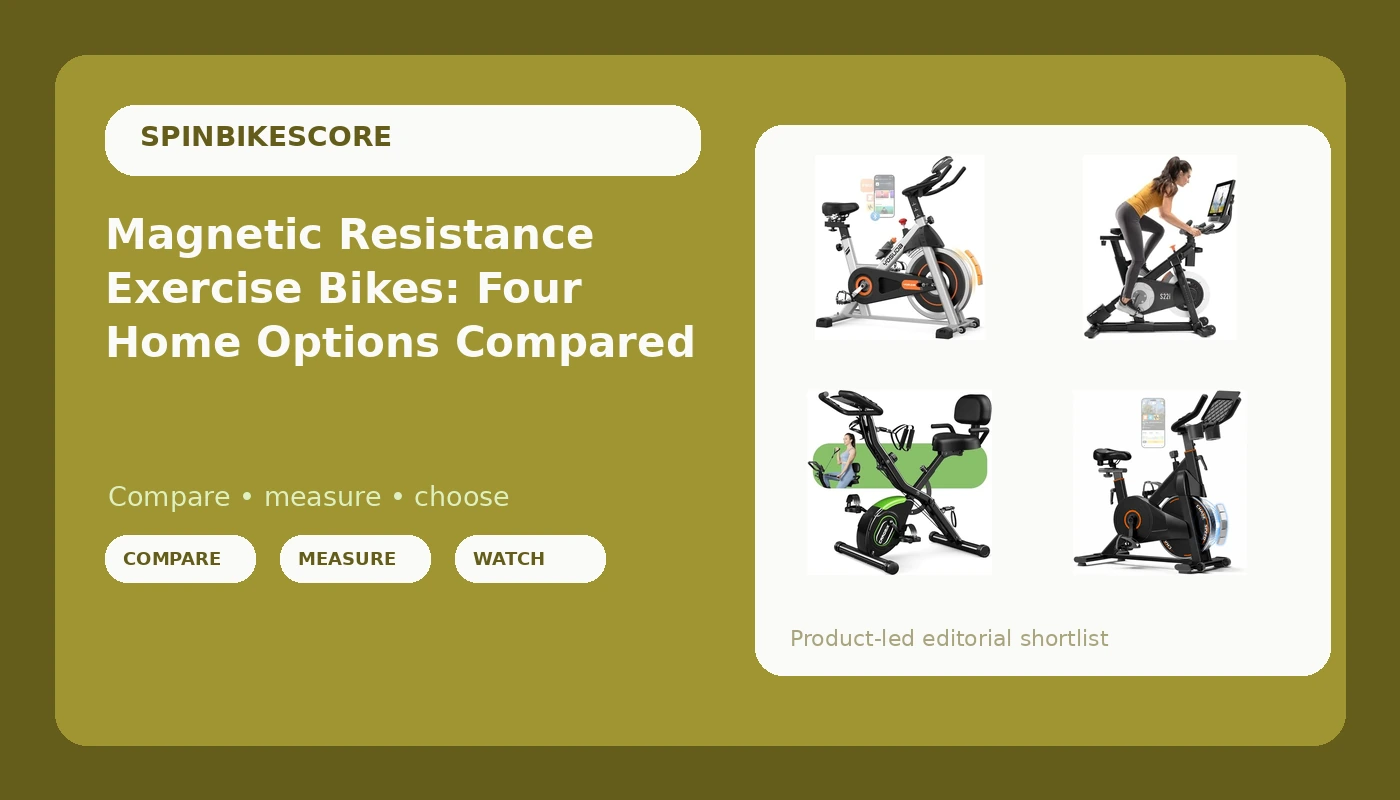
Buying a magnetic resistance exercise bike for a garage, a spare bedroom, or the corner of a living room comes down to a few things that marketing copy rarely answers: how the resistance engages under load, whether the frame stays planted when you stand on the pedals, and whether the seat and pedals will still be usable at month three. The four magnetic resistance exercise bikes in this explainer cover the realistic spread of what people actually buy, from a folding bike that disappears into a closet to a studio-style cycle that claims a permanent piece of floor. None of them is a commercial studio machine, and that is fine. What matters is matching the resistance type, the footprint, and the riding position to the way you actually ride. This is an explainer, not a scoreboard.
Related: How to Set Up a Spin Bike So Your Knees Stop Complaining →
Quick answer
Match the bike to your space and your riding style before you match it to a spec sheet. If storage is the constraint, a folding bike with adjustable magnetic resistance is the sensible starting point. If you ride hard and stand out of the saddle, a heavier studio-style cycle is the better shape. If you want the middle of the road, a straightforward magnetic bike with app training covers it. Resistance type alone does not tell you much, because a well-built bike with a wide resistance range will serve you better than a cheap bike with a fashionable label on the resistance knob.
Four useful options
| Model | Best fit | What stands out |
|---|---|---|
| CURSOR Exercise Bike, Magnetic Stationary Bikes for Home with App Training | A first home bike with app-guided rides | Magnetic resistance and app training support in an upright frame |
| YOSUDA Exercise Bike, Magnetic Friction Stationary Bike with App Training | Riders who want app training without a studio footprint | Magnetic friction resistance paired with app training |
| Nordictrack Commercial Studio Cycle | Riders who want a studio-style bike at home | Commercial studio cycle form factor |
| Caromix Folding Exercise Bike, 5 in 1 Stationary Bike | Small rooms and riders who want more than one position | Folding frame, 16 resistance levels, 5-in-1 design, 330 lb stated capacity |
The entry-level option: CURSOR Exercise Bike
This is the shape most people picture when they think about a home exercise bike: an upright frame, a resistance knob, a small console area, and a seat that will probably be the first thing you want to change. Magnetic resistance is the right call at this end of the market because it does not shed pad dust and it does not change feel as it wears the way a friction pad does. The trade-off with any entry-level upright is adjustability. Seat and handlebar posts on cheaper bikes often move in coarse steps, which makes it harder to dial in a position that keeps your knees tracking straight. If your household has riders of very different heights, that matters more than any other spec on the page.
The app-training option: YOSUDA Exercise Bike
Read the resistance wording on this one carefully, because "magnetic friction" is a phrase that gets used loosely across budget listings. In practice it usually describes a system where magnets do the braking work while some part of the assembly still contacts the flywheel, or it describes a magnetic system with a friction-style adjustment knob. Either way, the thing you want to know before ordering is what the knob feels like across the full range: does resistance build smoothly from easy to hard, or does nothing happen for the first five turns and then everything happen at once? A bike that goes from flat to impossible in half a rotation is a bike you will fight every session. App training support is the other half of the pitch here, and it is genuinely useful if you struggle to structure your own intervals.
The studio-style option: Nordictrack Commercial Studio Cycle
Studio-style cycles are a different animal from the two uprights above, and the difference is mostly in the frame and the geometry. The riding position puts your hands forward and your hips in a posture closer to a road bike, which is what makes standing climbs and sprints feel natural instead of awkward. That geometry also means the bike takes up more room and is harder to move, so this is a purchase you make when you have committed to a permanent spot. The other thing to weigh is that studio-style bikes tend to carry their own ecosystem assumptions, whether that is a subscription service, a specific app, or a screen you are expected to use. Decide up front whether you want the classes or just the hardware, because you are paying for both.
The folding option: Caromix Folding Exercise Bike
Folding bikes solve the problem that kills most home fitness purchases, which is the bike becoming furniture you have to walk around. A bike you can fold and tuck against a wall is a bike you will actually use in a small apartment. The trade-offs are real, though. Folding frames rely on a hinge and a locking mechanism, and that joint is the part most likely to develop play over time, which shows up as a rock or a click when you push hard. The multi-position design on this one is a plus for riders who want a recumbent-style seat position on some days and an upright position on others, and the 16 resistance levels give you finer steps between easy and hard than a bike with five or six. If you are buying for a household that includes older riders, the step-through frame and the lower seat position are the features that matter most.
Prices and availability may change. Product images, names, and retailer links are matched to verified listings. No current price, rating, stock status, or measured result is stated here without current evidence.
How magnetic resistance actually works
Magnetic resistance brakes the flywheel with magnets instead of a pad. Move the magnets closer to the metal wheel, or increase how much of the wheel they overlap, and the eddy currents that slow the wheel get stronger. There is no contact, so nothing wears down, nothing sheds dust, and the resistance does not fade as the parts age. That is why magnetic systems dominate the category now, and why "magnetic" shows up in almost every listing.
Friction resistance, the old standard, presses a felt or leather pad against the flywheel. It is cheap to build and it feels direct, but the pad wears, the resistance drifts as it does, and you eventually replace the pad. The phrase "magnetic friction" in a product name usually signals a hybrid or a loosely described magnetic system, so the honest move is to look at what the knob actually adjusts before you assume you are getting a pure magnetic brake.
Flywheel weight is the spec everyone quotes and the one that gets oversold. A heavier flywheel smooths the pedal stroke because it carries momentum through the dead spots at the top and bottom of the revolution. But weight only helps if the frame can hold it steady. A heavy flywheel in a flexy frame is worse than a moderate flywheel in a rigid one, because the flex shows up as a wobble exactly when you are standing and pushing hardest.
Two more things worth understanding. First, the resistance range matters more than the resistance type. A magnetic bike with a narrow range will feel fine when you are seated and spinning, and useless the moment you want to stand and grind. Second, Q-factor, the width between the pedals, is the spec nobody lists and everybody feels. Wide pedal spacing pushes your knees outward and they will complain at minute twenty, not minute two.
What to check before you buy
- Measure the floor space, including the width of the handlebars and enough clearance to stand beside the bike and swing a leg over it.
- Decide whether you ride seated or standing. Standing sprints put far more torque through the frame, and that is where cheap bikes reveal themselves.
- Look at how resistance is adjusted and how many steps it offers. A knob with a wide, smooth sweep beats a knob with five positions.
- Read the seat and pedal spec and assume you may replace both. Factor that into what you are willing to spend.
- Check the stated rider height and weight range against everyone who will use the bike, not just you.
Practical guidance
- Set saddle height before you judge anything else. A saddle an inch too low will make a good bike feel terrible.
- Put a mat under the bike and check the floor contacts. A bike that rocks on a hard floor will rock more when you stand.
- Expect to swap the seat on most bikes in this price band. A wider, padded saddle is the cheapest upgrade you can make.
- Wipe the frame down after sweaty rides. Sweat is the reason cheap paint and cheap hardware fail early.
- Recheck the bolts at the seat post, handlebar post, and pedals after the first few weeks, then again around month three.
Which option should you choose?
Choose the CURSOR Exercise Bike when you want a straightforward upright magnetic bike with app-guided rides and you are setting up your first home setup. Choose the YOSUDA Exercise Bike when you want app training and magnetic resistance in a simple upright format and you are comfortable checking the resistance feel yourself. Choose the Nordictrack Commercial Studio Cycle when you ride hard, stand out of the saddle, and want a studio-style position and frame rather than a basic upright. Choose the Caromix Folding Exercise Bike when floor space is the constraint, when you need a step-through frame, or when you want adjustable magnetic resistance and multiple riding positions in one bike.
One caveat that applies to all four: the categories overlap more than the marketing suggests. A folding bike used seated at moderate resistance and a studio cycle used for standing sprints are different purchases solving different problems, and the right answer depends on how you ride rather than on which listing has the longest feature list.
The bottom line
There is no single winner here, because these four bikes are built for four different rooms and four different riders. If you have space and you ride hard, a studio-style cycle is the shape that will hold up. If you are tight on floor space, a folding bike with adjustable magnetic resistance keeps the habit alive instead of turning into clutter. If you want the middle ground, an upright magnetic bike with app training covers the majority of home riders. Whatever you pick, plan on a new seat, a mat, and a wrench set by the door. That is the honest cost of riding indoors.