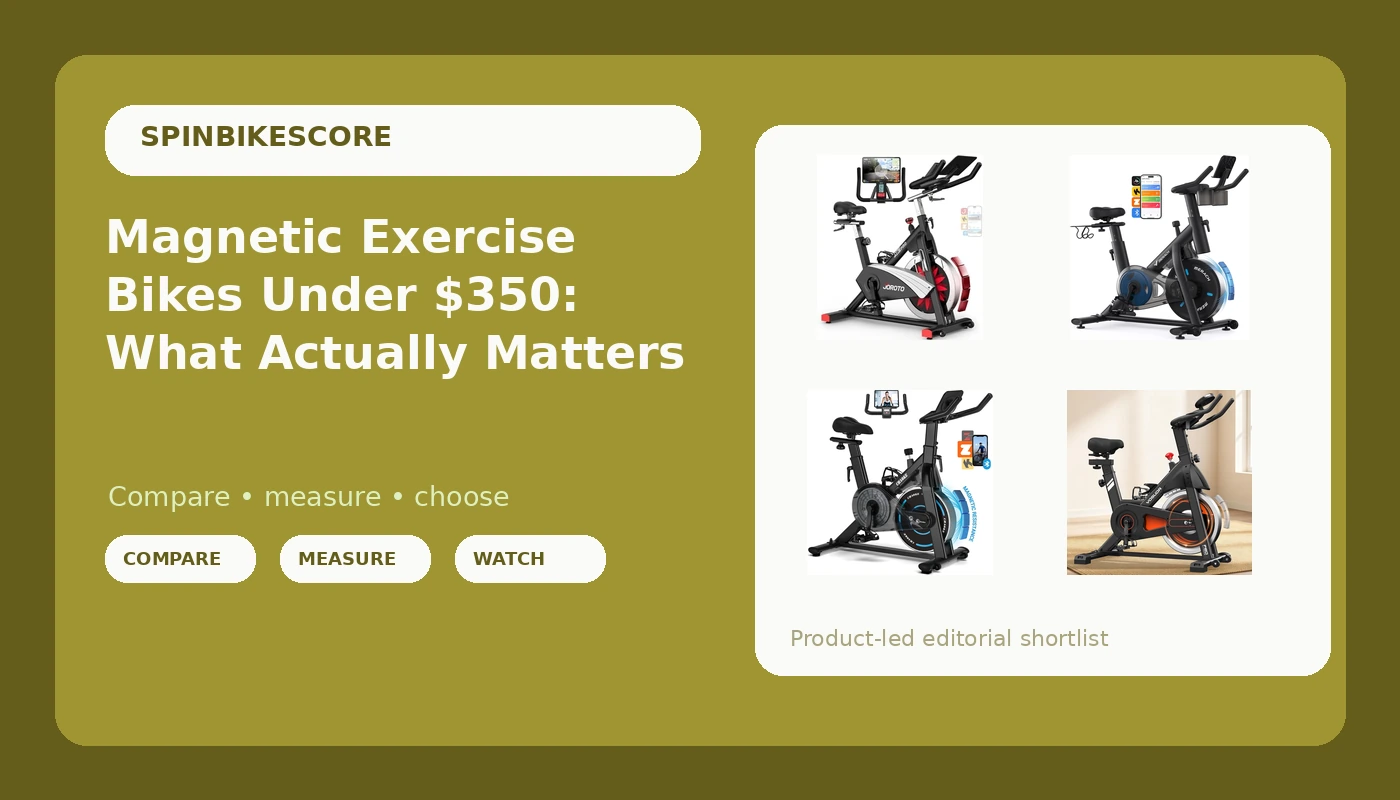
Shopping for magnetic exercise bikes in the budget tier is an exercise in reading between the lines. Four bikes can list the same three phrases, magnetic resistance, app compatible, comfortable seat, and still feel completely different at mile twenty, when your knees have started tracking wide, the seat has gone from cushioned to concrete, and the resistance knob is slipping under load. The listings themselves are not usually dishonest. They are just incomplete. What they tend to leave out is the short list of details that decides whether a bike becomes a habit or a clothes rack: the rider weight the frame is rated for, whether the magnetic resistance is smooth across its whole range or only at the top, how far apart the pedals sit, and whether the saddle is something a human can sit on for 45 minutes.
This is an explainer for that decision. It covers four specific budget bikes, what each listing actually states, and the fit and mechanics questions that matter more than the copy on the box.
Related: How to Set Up and Fit a Spin Bike to Your Body →
Quick answer
All four of these are home exercise bikes with magnetic resistance, and all four are aimed at the same buyer: someone who wants indoor cycling cardio without a studio subscription or a four figure frame. The stated differences are narrow but real. Two of them list a rider weight capacity (the CHAOKE at 300 lb, the YOSUDA PRO at 350 lb). Two name app compatibility in the product name (the CHAOKE and the MERACH). One, the MERACH, uses the phrase "magnetic friction," which is worth understanding before you buy. None of the four listings as recorded here states a flywheel weight, a Q-factor, or a measured noise level, so treat any assumption about those as unverified until you confirm it.
4 useful options
| Model | Best fit | What stands out |
|---|---|---|
| CHAOKE Quiet Adjustable Magnetic Resistance Exercise Bike | Riders at or under the listed 300 lb capacity who want app guided cardio on a small budget | Lists a 300 lb weight capacity, app compatibility, adjustable magnetic resistance, and a digital display |
| JOROTO Magnetic Stationary Exercise Bike | Riders who want a plain magnetic home bike and are willing to confirm details before buying | Listed as a magnetic stationary bike for home; the thinnest specification detail of the four |
| MERACH Magnetic Friction Exercise Bike with App | Riders who want app integration and a friction style resistance feel | App listed in the product name; resistance described as magnetic friction |
| YOSUDA PRO Magnetic Exercise Bike 350 lbs Weight Capacity | Heavier riders, or anyone who wants headroom for standing work | Lists a 350 lb weight capacity, the highest of the four here |
The entry point: CHAOKE Quiet Adjustable Magnetic Resistance Exercise Bike
Of the four, this is the listing that tells you the most about what you are getting. A stated 300 lb capacity is a real number you can work with, because you can compare it against your own body weight and decide how much margin you want. App compatibility is a genuine feature if you plan to follow guided rides, and it is close to meaningless if you were going to ride to your own music anyway. The word "quiet" in the name is the part to hold loosely. Magnetic resistance removes the friction pad, which is the main source of grinding noise on cheap bikes, but noise also comes from the bottom bracket, the pedals, and the frame under load, and none of those are covered by the phrase. Treat it as a design intent, not a measurement.
The plain magnetic option: JOROTO Magnetic Stationary Exercise Bike
A sparse listing is not a bad bike. It is an unverified one. When a product page does not state a capacity, you cannot assume it matches the others, and the frame is the one component you cannot upgrade later. If this is the bike you are considering, the questions to resolve first are the ones that decide long term satisfaction: what rider weight is it rated for, what is the seat post adjustment range, does the resistance change smoothly or in steps, and what pedals ship with it. Those answers exist, they simply are not in the name. Anyone who has ridden a bike that flexes under a standing climb knows this is not a cosmetic concern.
The app and friction option: MERACH Magnetic Friction Exercise Bike with App
The phrase "magnetic friction" deserves a plain translation, because it is not a standard engineering term. Magnetic resistance works by moving magnets closer to a spinning metal flywheel, and the braking force comes from eddy currents rather than contact. Friction resistance works by pressing a felt or leather pad against that same flywheel. The first has no wearing surface. The second does, and pads need periodic replacement, especially for daily riders. A listing that uses both words may be describing a hybrid system, or it may simply be mixing vocabulary. Either way, the practical question is the same: is there a pad touching the wheel, and if so, how do you replace it and how much does the replacement cost?
The capacity leader: YOSUDA PRO Magnetic Exercise Bike 350 lbs Weight Capacity
Capacity ratings are usually read as a limit, and they are more useful when you read them as headroom. A bike is rated for a static load, but indoor cycling is not static. Standing climbs shift your weight side to side, and the frame, seat post, and handlebar assembly all see loads well past your body weight during a hard interval. That is why the rating matters more for riders who plan to stand and sprint than for riders who stay seated. If you are near the top of a bike's stated range, the honest expectation is that you will notice flex before a lighter rider does, and the seat post and pedals become the first parts to watch.
Prices and availability may change. Product images, names, and retailer links are matched by verified product identifier. No current price, rating, stock status, or measured result is stated here without current evidence.
What the listed specs do and do not tell you
A magnetic resistance listing tells you the braking system does not use a wearing pad, in most cases. That is a genuine durability advantage over felt pad bikes, and it is the main reason magnetic systems have taken over the budget category. What the phrase does not tell you is how the resistance is transmitted. Some bikes use a threaded rod and a knob that moves magnets in fine increments, so you can add a single percent of effort at a time. Others use a lever with a handful of detents, which is fine for steady riding and clumsy for intervals where you want to nudge resistance mid effort. A third group uses a plastic knob on a plastic housing, which is the combination that tends to develop play, and play at the resistance knob is what riders describe as slipping.
Two other numbers are almost always missing. The first is flywheel weight. A heavier wheel smooths the pedal stroke because it stores momentum and carries you through the dead spot at the top and bottom of the stroke, which is exactly the quality you feel when you stand up. It also means more energy to bring back down, and since the resistance knob on a spin bike doubles as the emergency brake, a heavier wheel takes longer to stop. The second missing number is Q-factor, the distance between the pedals. A wide stance pushes your knees outward, and riders feel that as outside knee ache after twenty minutes rather than immediately. Neither figure appears in any of the four listings here, so neither should be assumed.
What the listings do give you is a starting filter. A stated capacity, a named resistance type, and app compatibility are the three claims that are easy to verify and hard to fake. Everything else is marketing until you confirm it.
What actually decides whether you keep riding
The bikes that end up unused are rarely the ones with the weakest specs. They are the ones that were uncomfortable or unstable in a way the buyer did not expect. Work through these five steps before you choose.
- Compare your body weight to the stated capacity, and leave margin for standing work. If a bike does not state a capacity at all, get that answer before you buy, because the frame is not upgradeable.
- Measure your inseam and check the seat post adjustment range. A bike that cannot reach your pedaling position will hurt your knees no matter how good the resistance feels.
- Identify the resistance mechanism: magnetic only, magnetic with a pad, or lever stepped. Magnetic with fine adjustment is the most versatile for interval work.
- Decide honestly whether you will use the app. If you ride to your own playlists, app compatibility should not be a deciding factor or a reason to pay more.
- Budget for a replacement seat and possibly pedals. On most budget bikes the saddle is the first part riders swap, and plastic pedal cages are the second.
Setting up a budget bike so you ride it
- Set saddle height first, at roughly hip height when you stand beside the bike, then fine tune so your knee keeps a slight bend at the bottom of the stroke.
- Check the seat post clamp and the handlebar clamp with a wrench before the first ride and again after the first week. New bikes settle.
- Put the bike on a hard, level surface rather than carpet. Carpet is where wobble at sprint speed comes from, and it is a stability problem, not a comfort problem.
- If the saddle hurts at mile twenty, replace it instead of enduring it. A saddle that fits is the cheapest performance upgrade on any bike.
- Test the resistance knob through its full range early, and note whether it holds position under hard effort. If it creeps, address it before it becomes a habit.
Which option should you choose?
Choose the CHAOKE Quiet Adjustable Magnetic Resistance Exercise Bike when you want the most completely described budget option, you are within its listed 300 lb capacity, and app guided rides are part of your plan. Choose the JOROTO Magnetic Stationary Exercise Bike when you want a simple magnetic home bike and you are comfortable confirming capacity, fit range, and pedal type with the seller before you order. Choose the MERACH Magnetic Friction Exercise Bike with App when app integration appeals to you and you confirm what part of the resistance system contacts the flywheel. Choose the YOSUDA PRO Magnetic Exercise Bike 350 lbs Weight Capacity when the highest stated capacity in this group matters to you, either because of your body weight or because you want headroom for standing intervals.
The limitation to keep in view is that none of these four listings, as recorded here, publishes flywheel weight, Q-factor, or a measured noise figure. That means the comparison above is built on stated capacity, listed resistance type, and named features rather than on ride feel. A bike can look identical on paper and feel completely different at sprint resistance. If any of those three missing numbers decides your purchase, ask before you buy rather than assuming.
The bottom line
The budget magnetic exercise bike category has converged on a similar formula: a steel frame, a magnetic brake, a digital display, and a seat that most riders eventually replace. What separates these four is how much they tell you up front. Two state a rider weight capacity, and the YOSUDA PRO states the highest of the group at 350 lb. Two name app compatibility, the CHAOKE and the MERACH. One, the MERACH, uses a resistance term that blends magnetic and friction, which is worth clarifying before you commit.
The right way to use this list is to filter first on capacity relative to your own weight and how much standing work you plan to do, then on resistance mechanism, then on whether the app matters to you. Everything after that, seat comfort, pedal quality, knob feel, is adjustable or replaceable. The frame rating is not.