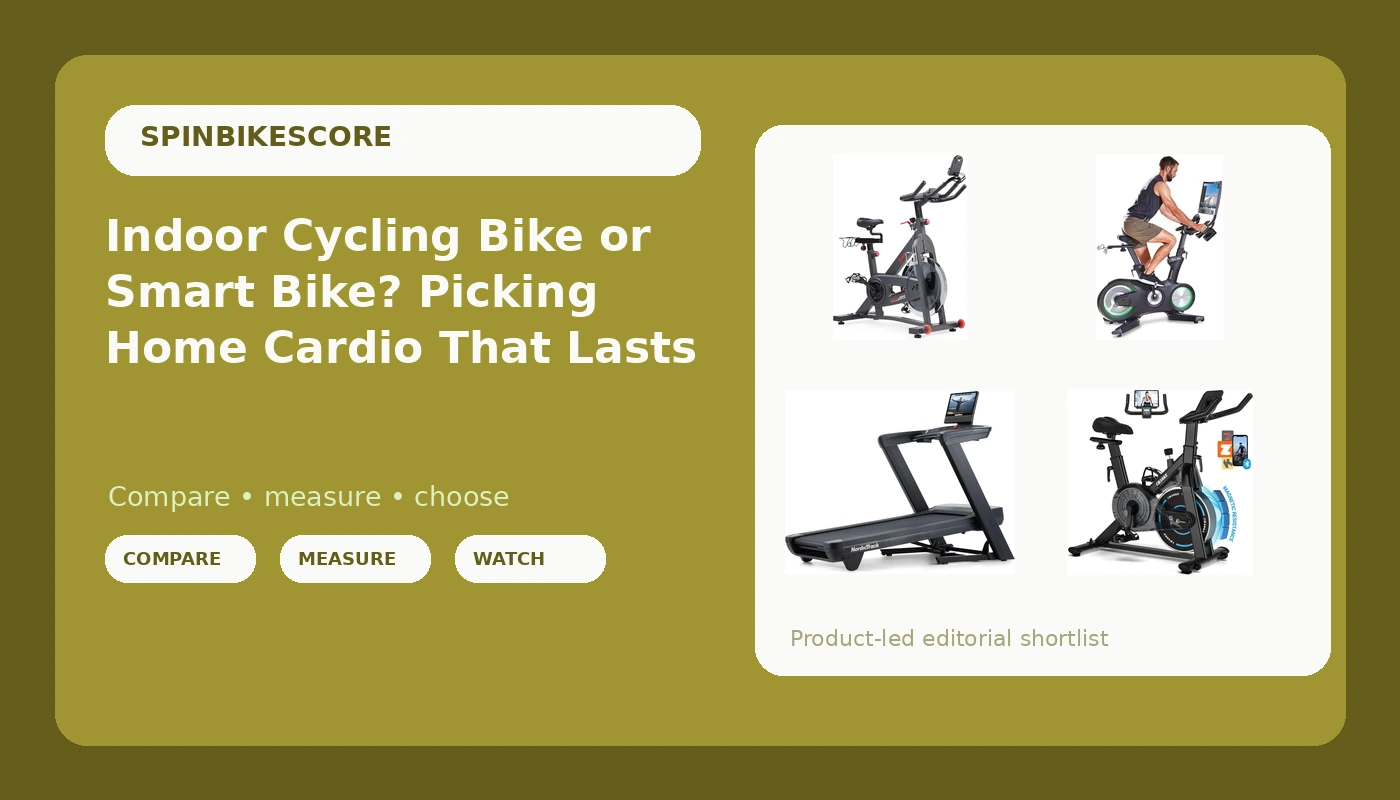
Most people shopping for home cardio start with the same question: which machine, and how much do I have to spend before it stops feeling like a toy? The honest answer depends less on brand than on three things: how you plan to ride, how much floor space you can give up, and whether you want a screen coaching you or your own music and a timer. This guide compares four options across the price ladder, from a budget magnetic indoor cycling bike to a connected bike with a built-in touchscreen to a treadmill line, and explains what each one is actually for, so you can match the machine to the riding you will really do at 6 a.m. in February.
Related: How to Set Up a Spin Bike So Your Knees Stop Complaining →
Quick answer
For most riders building a first home cardio corner, a magnetic resistance indoor cycling bike is the lowest-risk starting point. It is compact, it is low impact, magnetic resistance does not wear out the way felt pads do, and routine maintenance is mostly tightening bolts and checking the pedals. Step up to a connected bike only if you know you will use the built-in screen and its class library. Choose a treadmill only if running is genuinely part of your plan, because it is the one machine in this group that supports running, and it is also the largest and heaviest of the four.
Four useful options
| Model | Best fit | What stands out |
|---|---|---|
| Sunny Health & Fitness Smart Indoor Cycling Exercise Bike for Home Cardio | Riders who want one bike for everyday cardio with app-based training | A smart indoor cycling bike positioned between basic budget bikes and screen-equipped models |
| Exercise Bike, CHAOKE Quiet Adjustable Magnetic Resistance Stationary Bike | First-time buyers and smaller rooms | Magnetic resistance, app compatibility, a 300 lb weight capacity, a padded seat, and a digital display |
| Echelon Connect EX-8s Smart Exercise Bike | Riders who want the screen and the class library built into the bike | 24 inch HD touchscreen, 32 resistance levels, SPD pedals, dumbbell holders, USB port, and a 30-day Echelon Fit app membership |
| NordicTrack Commercial Series Treadmills: Commercial 1250, 1750, 2450 | Households that want running and walking alongside cycling | A three-model treadmill line in the Commercial series, from the 1250 up to the 2450 |
The balanced first bike: Sunny Health & Fitness Smart Indoor Cycling Exercise Bike for Home Cardio
This is the category most riders should look at first, because it does not force you to choose between a stripped-down bike and a subscription ecosystem. You bring the phone or tablet, mount it, and pick your own app or workout. The trade-off is that you are responsible for the entertainment and the programming: no screen means no guided class unless you supply one, and no screen also means one less electronic component to fail. If you have ever had a tablet die mid-class, you already know why that matters. It also keeps the footprint smaller than a screen-equipped bike, which matters in a spare bedroom or apartment.
The budget entry: Exercise Bike, CHAOKE Quiet Adjustable Magnetic Resistance Stationary Bike for Home Cardio with App Compatible, 300LB Weight Capacity Indoor Cycling Bike with Comfortable Seat & Digital Display
This is where most people start, and it is a legitimate place to start. Magnetic resistance at this price is the important part: it means no felt pad grinding against a flywheel and wearing a groove into it over a year of daily rides. The 300 lb weight capacity also puts it in a different class than the flimsiest budget bikes. The honest caveats are the ones that apply to nearly every bike at this end of the market. The seat is the first component most riders replace, so budget for that possibility, and expect to re-tighten the pedals, seat post, and handlebar bolts after the first few rides. A digital display of this type gives you basics like time, speed, and distance rather than power, so treat the numbers as a pacing tool, not a training metric.
The connected upgrade: Echelon Connect EX-8s Smart Exercise Bike with 24 Inch HD Touchscreen, LED Flywheel, Bluetooth, 32 Resistance Levels, SPD Pedals, USB Port, Dumbbell Holders & Free 30-Day Echelon Fit App Membership
This is the option for riders who already know they want a class library on a big screen and do not want to prop up a tablet. The details worth noticing are the ones that affect daily use: 32 resistance levels give you finer jumps between easy and hard than a knob with a short range, SPD pedals mean you can clip in if you own cycling shoes, and the dumbbell holders let you add upper body work without leaving the bike. The USB port handles charging. The trade-offs are real too. The screen ties a chunk of the experience to the Echelon Fit app, the free membership runs 30 days and then becomes an ongoing cost if you keep using classes, and a bike this size takes up more room than a basic indoor cycling bike. SPD pedals also assume you either own the right shoes or are willing to buy them, since flat-pedal riders will need to swap pedals or add adapters.
The cross-training option: NordicTrack Commercial Series Treadmills: Commercial 1250, 1750, 2450
This one is on the list for a specific reason: it is the only machine here that lets you run. If your plan includes a 5K, a walking habit, or run-and-ride weeks, no indoor cycling bike substitutes for it, no matter how good the bike is. Because it is a line rather than a single machine, the decision inside the decision is which model fits your space and your training volume, with the 1250 as the entry point and the 2450 at the top of the series. The practical costs are different from a bike: treadmills are heavier and larger, they need more clearance behind the belt, and they need belt lubrication and deck inspection on a schedule. Impact is also higher, which is exactly why some riders keep a bike for the hard days and a treadmill for the days their joints want something else.
Prices and availability may change. Product images, names, and retailer links must be matched by verified ASIN. Do not state a current price, rating, stock status, or measured result without current evidence.
How resistance type changes the ride
Resistance is the part of a bike you feel on every single pedal stroke, and it is the part most buyers ignore. Felt pad resistance presses a pad against the flywheel. It works, it is cheap, and on a well-built bike it feels fine. The problem is wear: the pad thins, the resistance drifts, and you end up turning the knob further each month to get the same effort. Magnetic resistance uses magnets moving closer to or further from the flywheel. There is no contact, so nothing wears down, the change between levels is smoother, and there is no pad dust collecting under the bike. That is why a magnetic bike at a modest price is usually a better long-term buy than a felt-pad bike that looks sturdier in photos.
Flywheel weight matters too, but less than the marketing suggests. A heavier flywheel smooths the pedal stroke and holds momentum, which feels better when you are standing and sprinting. A lighter flywheel can still ride well if the frame is stiff and the resistance is smooth. The failure mode to watch for is not a light flywheel, it is a frame that flexes. Flex is what makes a bike feel unstable when you stand up at high resistance, and instability is a safety issue, not just an annoyance.
The five things that decide whether you keep riding
Comfort and fit beat specifications, every time. A bike you avoid because the seat hurts is worth nothing, no matter what the spec sheet says.
- Measure your space, including ceiling height and the clearance behind a treadmill belt. Write the numbers down before you shop.
- Decide whether you want a screen or your own device. A built-in touchscreen is convenient and ties you to an app; a phone or tablet mount is cheaper and more flexible.
- Check the resistance mechanism. Magnetic is smoother and does not wear out; felt pads are acceptable only if the rest of the bike is built well.
- Plan for the contact points. Seats, pedals, and shoes are the three things riders replace or upgrade first, and all three affect comfort more than frame specs.
- Set a realistic weekly target. Three rides a week on a modest bike beats one ride a month on an expensive one, and your target should decide how much bike you need.
What to do in the first two weeks
- Set saddle height so your knee stays slightly bent at the bottom of the pedal stroke, then adjust fore and aft so your knee tracks over the middle of the foot.
- Ride five minutes, then check every bolt you can reach: pedals, seat post clamp, handlebar clamp, and the stabilizer feet.
- Give the seat a fair trial but keep a replacement in mind, since seats are the most common first upgrade on any new bike.
- Put a mat under the bike or treadmill, and check that the machine sits level on the floor rather than rocking on one corner.
- If you bought a connected bike, use the included membership period to decide whether the class library is something you will actually pay for.
Which option should you choose?
Choose the Sunny Health & Fitness Smart Indoor Cycling Exercise Bike when you want one versatile bike for everyday cardio and you are happy to run classes from your own phone or tablet. Choose the CHAOKE Exercise Bike when budget and floor space are the deciding factors and you want magnetic resistance at the lowest cost. Choose the Echelon Connect EX-8s when the built-in screen, the class library, and clip-in pedals are exactly the experience you are shopping for. Choose the NordicTrack Commercial Series Treadmills when running or walking has to be part of your training and no bike will do.
One caveat before you commit: specifications, included memberships, and pricing on all four of these change over time, and this article does not carry current prices or ratings. Verify the details on the product page before you buy, and check the return window, because the first two weeks are when you find out whether a bike fits you.
The bottom line
There is no single right machine here, only a right match. A magnetic indoor cycling bike covers low-impact cardio in a small footprint and is the safest first purchase for most homes. A connected bike trades money and space for a screen and a class library, which is worth it only if you will use them. A treadmill is the only option in this group that lets you run, and it comes with a bigger footprint and a different maintenance routine. Pick the machine that fits your room and the riding you will actually do, budget for a seat or pedal swap, and expect to tighten a few bolts in the first month. That is the whole decision.