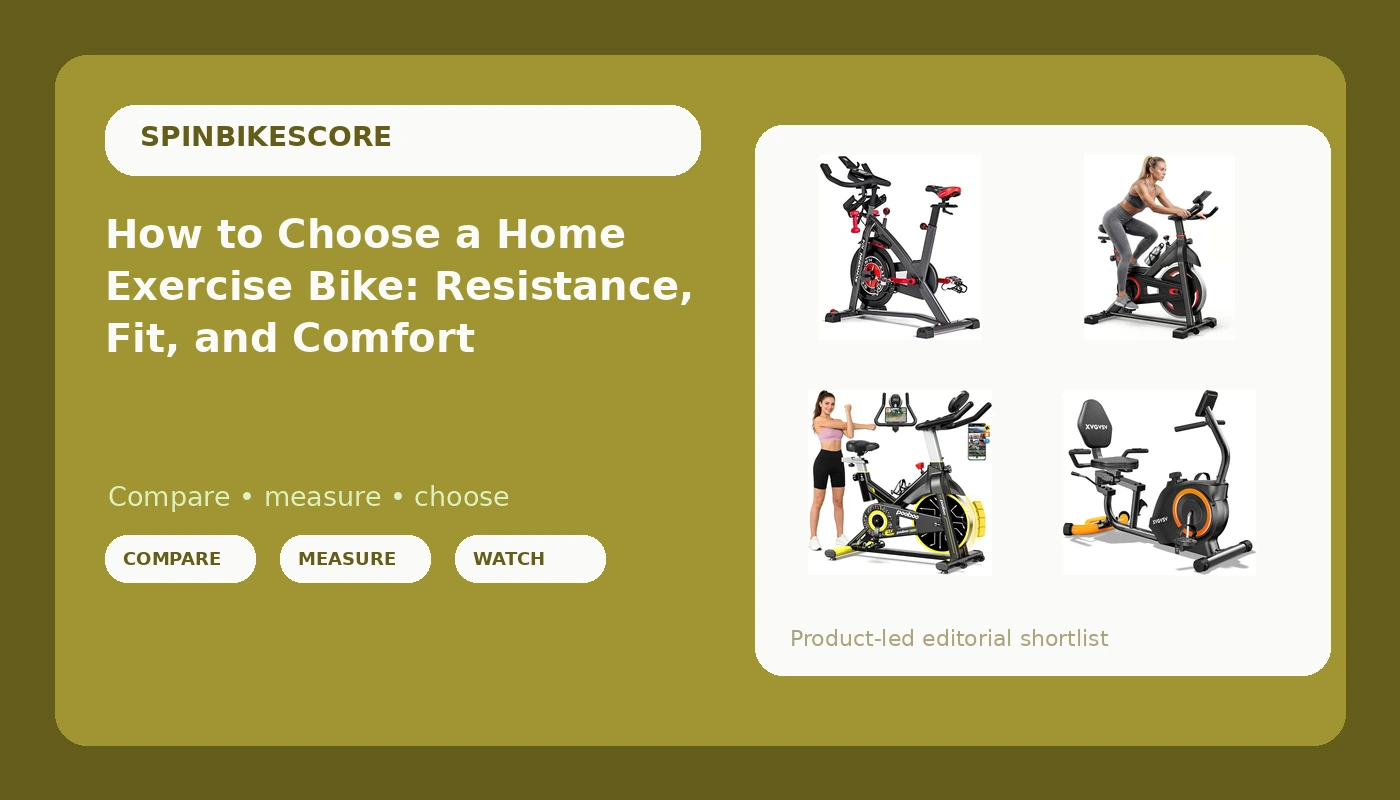
Buying a home exercise bike is not really a spec-sheet decision. It is a fit decision, a resistance decision, and a comfort decision, in that order. The problem is that almost every listing you will read leads with the things that matter least, like app compatibility and how many workout programs are built in, and buries the things that matter most, like how wide the pedals sit apart and whether the resistance will still feel smooth in month four. This guide walks through a home exercise bike purchase the way a rider actually experiences it, from the first pedal stroke to the twentieth mile, and it uses four very different bikes to show how the same set of questions produces different answers depending on who is riding.
Related: How to Set Up a Spin Bike for Your Height →
Quick answer
There is no single best home exercise bike, because the right frame style depends on your body and your goals. An upright or studio-style bike suits riders who want to stand and sprint. A recumbent suits riders who want back support and a step-through entry. Magnetic resistance generally runs smoother and quieter than felt pads and does not wear out the same way, though a well-built felt-pad bike can still be a good ride. Before you buy anything, confirm three things: the seat and handlebars adjust into a position you can hold for 30 minutes, the frame does not wobble when you push hard, and the pedals are not plastic cages that will crack. Do not accept a "quiet" claim without knowing what mechanism produces the quiet.
Four useful options
| Model | Best fit | What stands out |
|---|---|---|
| Schwinn Fitness IC Indoor Cycling Bike Series | Riders who want a studio-style spin frame | A recognizable name in indoor cycling; the series covers multiple models, so the resistance type depends on which version you choose |
| NEWBULIG Exercise Bike with APP, Stationary Bikes for Home, Workout Bike for Adults & Seniors, Cycle Machine, Adjustable Height and Resistance, Low Noise, 265lbs Weight Capacity, Easy Assembly | Smaller spaces and riders who want simple height and resistance adjustment | The listing names a 265 lbs weight capacity, adjustable height and resistance, and easy assembly |
| Exercise Bike,Stationary Bike for Home,Magnetic Indoor App Cycling Bike | Riders who want magnetic resistance at a budget price | Magnetic resistance and app connectivity are built into the product name |
| Recumbent Exercise Bike for Home, Recumbent Stationary Bikes for Seniors | Riders who want a back-supported, step-through position | A recumbent layout, which as a category puts the rider in a reclined, supported position |
The studio-style option: Schwinn Fitness IC Indoor Cycling Bike Series
The reason to start here is geometry, not branding. An upright spin frame puts your hands forward and your hips over the pedals, which is the position that lets you shift weight between the saddle and the handlebars as resistance climbs. That is the position a class is built around. The trade-off is that this same geometry is unforgiving if your fit is wrong: an upright bike with the saddle too low will make your knees complain faster than any other style. It also tends to ask more of your lower back than a recumbent, because nothing behind you is holding you up. If you have never ridden a spin-style bike, this is the shape to try before you commit, because it either feels immediately right or immediately wrong.
The budget option: NEWBULIG Exercise Bike with APP
The appeal of a bike at this price is that it removes the excuse. It is light, it assembles quickly, and it does not demand a dedicated corner of a room. The trade-off is that budget frames and budget saddles are where the money was saved, and that shows up in two places: the seat, which is usually the first part to replace, and the resistance, which may feel less consistent at the top of its range. A stated weight capacity is also a ceiling, not a target. If you are anywhere near 265 lbs, plan on a sturdier frame. What this bike does well is get a beginner pedaling, and for a lot of households that is the entire job.
The magnetic resistance option: Exercise Bike,Stationary Bike for Home,Magnetic Indoor App Cycling Bike
Magnetic resistance is the single most meaningful upgrade in this price bracket, and it is worth understanding why. Felt pads work by friction against the flywheel, which means the pad is a wear item: it sheds material, it can glaze, and the resistance changes slightly as it wears. Magnets do not touch anything, so there is nothing to replace and the feel stays consistent over time. The catch is that magnet strength and the shape of the resistance curve vary enormously between bikes, and a magnetic bike with a narrow usable range can feel like it goes from easy to impossible in two turns of the knob. Ask yourself whether the resistance knob feels like it has usable steps in the middle, because that is where you will spend most of your ride.
Prices and availability may change. Product images, names, and retailer links must be matched by verified ASIN. Do not state a current price, rating, stock status, or measured result without current evidence.
The comfort option: Recumbent Exercise Bike for Home, Recumbent Stationary Bikes for Seniors
The honest trade-off with a recumbent is that it is not a spin bike and it will not feel like one. You cannot stand and sprint, your hip angle is open rather than closed, and the effort feels different because you are pushing against a backrest instead of balancing over the pedals. What you get in return is the ability to stay on the bike for 45 minutes without your seat bones filing a complaint. For riders with back issues, balance concerns, or a history of quitting exercise because it hurt, that trade is usually worth it. A recumbent is also the easiest style to read a book or watch television on, which matters more than most buying guides admit.
Resistance type and flywheel weight: what actually changes your ride
Two specs dominate exercise bike marketing, and they do different jobs. Resistance type determines how the bike feels over months of use. Flywheel weight determines how the pedal stroke feels within a single revolution.
Felt pad resistance is simple and cheap. A pad presses against the flywheel, and turning the knob increases the pressure. It works, and on a well-built frame it can feel perfectly good. The problem is that the pad is a consumable. It wears, it can squeak, and the resistance curve shifts as the material thins. If you ride daily, expect to be thinking about pad replacement within a year.
Magnetic resistance uses magnets positioned near the flywheel. Nothing touches, so nothing wears. The ride is generally smoother and the noise floor is lower, which is the mechanism behind most quiet-bike claims. Eddy current and electromagnetic systems are variations on the same idea, with the electronic version letting a console change resistance for you.
Flywheel weight is about inertia. A heavier flywheel carries momentum through the dead spots at the top and bottom of the pedal stroke, so the ride feels rounder rather than choppy. That is a real benefit. It also means the flywheel takes longer to slow down, which is why a heavy flywheel demands more control when you stop. Here is the part the marketing skips: flywheel weight only matters if the frame can hold it still. A heavy flywheel on a flexy frame is worse than a lighter flywheel on a rigid one, because the energy goes into the frame instead of your legs.
Fit, saddle comfort, and why the seat comes first
A bike that does not fit you is a bike you will not ride, and the fit problems on budget bikes are predictable.
- Set the saddle height so your knee has a slight bend at the bottom of the pedal stroke, not a locked leg and not a deep bend.
- Check the reach to the handlebars. If you are stretching, the bike is too long for you, and no amount of adjusting the seat will fix it.
- Sit on the saddle for ten minutes before you buy, or plan to replace it. On most budget bikes, the stock saddle is the weakest component.
- Look at the pedals. Plastic cages crack, and a cracked cage mid-sprint is how people get hurt.
- Push hard while standing. If the frame rocks or the handlebars flex, the bike is not built for the way you ride.
Practical guidance before you order
- Measure your space first, including the ceiling clearance you need if you stand up out of the saddle.
- Decide whether you want to stand and sprint. If yes, an upright or studio frame is the only option that works.
- Decide whether comfort or intensity is the priority. Recumbent for comfort, upright for intensity, and be honest with yourself.
- Budget for a replacement saddle and possibly pedals. That is a realistic line item, not an upsell.
- Confirm the resistance mechanism on the exact model you are ordering, especially with a series that spans multiple versions.
- Weigh the stated capacity against your own weight with a margin, not right at the limit.
- Prefer a bike whose resistance knob has usable steps in the middle of its range, because that is where your workouts live.
Which option should you choose?
Choose the Schwinn Fitness IC Indoor Cycling Bike Series when you want studio-style geometry and you plan to ride hard, stand, and sprint, and when you are willing to confirm which model in the series you are actually buying. Choose the NEWBULIG Exercise Bike with APP, Stationary Bikes for Home, Workout Bike for Adults & Seniors, Cycle Machine, Adjustable Height and Resistance, Low Noise, 265lbs Weight Capacity, Easy Assembly when you want the lowest barrier to entry, you weigh comfortably under the listed 265 lbs capacity, and you would rather start riding this week than research for another month. Choose the Exercise Bike,Stationary Bike for Home,Magnetic Indoor App Cycling Bike when magnetic resistance and app connectivity are the two features you care about most and you want them without paying a premium. Choose the Recumbent Exercise Bike for Home, Recumbent Stationary Bikes for Seniors when back support, a step-through frame, and long comfortable sessions matter more than sprinting.
The caveat that applies to all four: none of this substitutes for knowing your own body. Nothing here should be read as a measured performance claim about any specific unit, and no bike in this price range is a commercial studio machine. If you have an injury or a medical condition, talk to a professional before you build a training plan around a new bike.
The bottom line
The right home exercise bike is the one that fits your body, matches the way you actually want to ride, and has a resistance system that will still feel good in six months. Resistance type and frame rigidity matter more than app features or program counts, and the saddle is a wear item you should budget for rather than a selling point you should trust. If you want to stand and sprint, start with the upright studio-style frame. If you want smooth magnetic resistance on a budget, that option is here. If you want the lowest entry price, the budget pick gets you pedaling. And if comfort is the thing that has stopped you before, the recumbent is the one you will actually use. Check current Amazon price on each before you commit, and pick the one that matches your body rather than the one with the longest feature list.