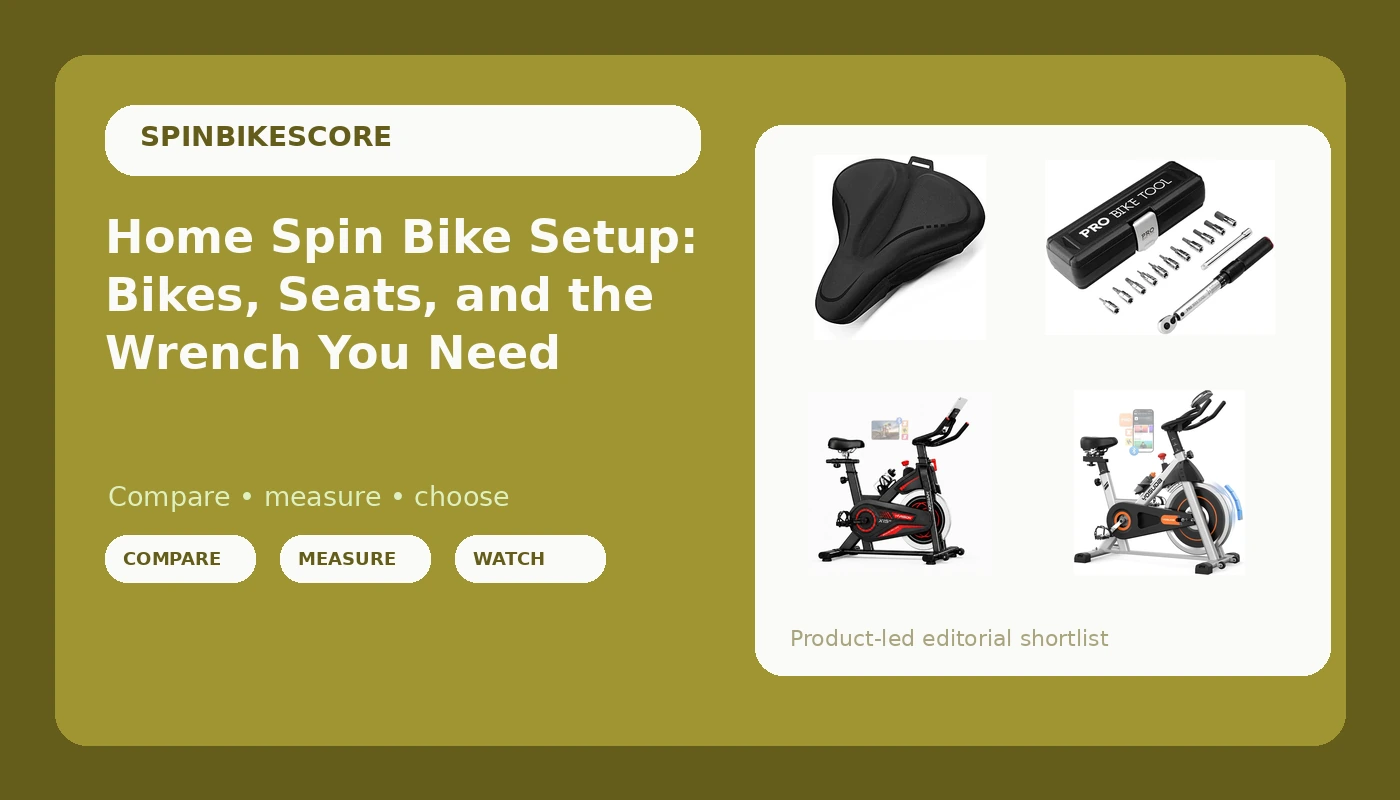
A home spin bike setup is four decisions, not one. The frame comes first, then the resistance mechanism, then the saddle, and then the tools you keep within arm's reach of the bike. Most people buy the frame and discover the other three the hard way: the stock saddle is the first thing to go, the handlebar bolts loosen after a few weeks of standing climbs, and the resistance system quietly determines whether year two feels like year one. After fourteen years of teaching indoor cycling, I can tell you the pattern holds whether the bike cost two hundred dollars or three thousand. This guide walks through four products that solve different pieces of that problem, and explains how to tell which piece you actually need.
Related: Magnetic Resistance vs Felt Pads: Which One Wears Better? →
Quick answer
A home spin bike setup works when the frame, the saddle, and the hardware are matched to how you ride. The HARISON Exercise Bike lists a 350 lb weight capacity, a tablet mount, Bluetooth app support, and a padded seat. The YOSUDA Exercise Bike is a magnetic friction stationary bike with app training support and a simpler build. If the saddle itself is what keeps you off the bike, the ANZOME Bike Seat Cushion adds wide foam and gel padding to an existing seat. And if you are assembling or re-tightening anything, the PRO BIKE TOOL Bike Torque Wrench Set covers the small-fastener range that cockpit and seat hardware uses.
Four useful options
| Model | Best fit | What stands out |
|---|---|---|
| HARISON Exercise Bike | Riders who want a stated high weight capacity and app connectivity | Listed 350 lb weight capacity, Bluetooth app, tablet mount, brake pad, padded seat |
| YOSUDA Exercise Bike | A straightforward magnetic bike with app training | Magnetic friction resistance, app training support, stationary home design |
| ANZOME Bike Seat Cushion | Anyone whose stock saddle is the reason they stop riding | Wide foam and gel padding, fits 8.5-10 in saddles, rain cover included |
| PRO BIKE TOOL Bike Torque Wrench Set | Assembly, adjustments, and month-three re-tightening | 1/4 inch drive, 2.2-16.9 Nm range for small fasteners |
The high-capacity frame: HARISON Exercise Bike
A stated weight capacity is one of the few specs that tells you something real about a frame before you ride it. More material usually means a heavier base, and a heavier base is what keeps a bike planted when you come out of the saddle at high resistance. The trade-off is the same material working against you when you want to move the bike across a room or up a flight of stairs. The listing describes both a magnetic system and a brake pad, which is worth reading carefully, because those two mechanisms behave differently over time. App connectivity is only as useful as the app you actually open, so check that the platform suits you before treating Bluetooth as a feature you will use.
The simpler magnetic bike: YOSUDA Exercise Bike
The name on this bike says both magnetic and friction, and that combination shows up constantly in budget listings. It is worth asking which one is doing the work, because the answer changes what maintenance looks like. A pure magnetic system has no contact between the braking surface and the flywheel, so there is nothing to wear down. A friction system presses a pad or brake against the flywheel, which feels smooth enough but consumes a replaceable part over time. Neither is automatically better, but they fail differently, and a pad is a consumable you should expect to think about. If you ride daily, that difference matters more than any spec on the box.
The comfort fix: ANZOME Bike Seat Cushion
A cushion is the cheapest experiment in cycling, and it is also the one people misjudge. It changes saddle height, so if you have already dialed in your fit, expect to raise the seat post a little to compensate. It also moves, unless the straps are pulled tight enough to keep it from sliding forward during a climb. And thickness has a ceiling: past a certain point, padding compresses, bunches, and creates pressure where a firmer surface would have spread it. A cushion fixes a saddle that is too hard. It does not fix a saddle that is the wrong shape or a bike that is set up at the wrong height.
The setup tool: PRO BIKE TOOL Bike Torque Wrench Set
Torque specs exist because fasteners have a window. Under-tighten a seat clamp and the post slips mid-ride. Over-tighten it and you can deform a clamp or crack a frame, and the damage usually shows up later rather than immediately. A wrench in this range is the right tool for cockpit and seat hardware. It is not the right tool for pedals, which are typically spec'd well above 16.9 Nm and need a larger drive. Buying one wrench that covers the small stuff is a reasonable starting point, because the small stuff is what actually comes loose on a stationary bike.
Prices and availability may change. Product images, names, and retailer links are matched to verified listings. No current price, rating, stock status, or measured result is stated here without current evidence.
Magnetic resistance versus friction pads
The resistance mechanism is the part of a spin bike that most buyers skip past, and it is the part that determines how the bike feels in month two versus month twelve. Magnetic resistance uses magnets that move closer to or further from the flywheel to change how hard it is to pedal. Nothing touches, nothing wears, and the resistance curve tends to feel consistent across the whole range of the knob. Friction resistance presses a pad, brake, or felt block against the flywheel. It is a simpler design, it is often louder, and the contact surface degrades with use.
That degradation is the reason felt pads get a reputation. On a bike that sees twenty miles a week, a pad can last a long time. On a bike that sees fifty, you will notice the resistance knob needing more travel to produce the same effort, and eventually you replace the pad. It is not a design flaw so much as a consumable, the same way brake pads on a car are a consumable.
Flywheel weight gets marketed heavily, and it is worth understanding what it actually does. A heavier flywheel stores more momentum, which smooths the transition between the downstroke and the upstroke and makes the pedal stroke feel more like riding outdoors. It also takes more effort to accelerate and more effort to stop. Weight is not the same as quality, and a heavy flywheel on a flexy frame is a worse experience than a moderate flywheel on a rigid one.
The third variable, and the one nobody puts on the box, is stability under load. A bike can feel perfectly solid while you sit and pedal and then wobble noticeably the moment you stand up at high resistance. That is a frame and base problem, not a flywheel problem, and it is the single biggest reason a cheap bike feels cheap. When you are evaluating any home bike, think about the position you will actually ride in, not the position that photographs well.
Assembling and re-tightening a home spin bike
Most home bikes arrive partly assembled, and most of them loosen up in the first few weeks as the frame settles. Here is a routine that keeps a bike tight without stripping anything.
- Read the assembly torque values in the manual and write them down, because you will not want to dig the manual out again in three weeks.
- Set the torque wrench to the spec for the fastener in front of you, not to a number you remember from a different bolt.
- Tighten in a cross pattern on any four-bolt clamp, bringing each bolt up in stages rather than taking one to full torque first.
- Re-check the seat clamp, handlebar clamp, and pedal threads after the first week of riding, since those are the joints that move under load.
- Check the stabilizer feet and base bolts monthly, because a base that has shifted is what turns a small wobble into a noticeable one at sprint resistance.
What to check before you commit
- Measure your space first, including the ceiling if you plan to stand and sprint, and remember that a heavier frame is harder to reposition.
- Sit on the bike in the position you actually ride, not the upright position you use for the first thirty seconds.
- Confirm whether the resistance is magnetic, friction, or both, and ask what part wears out if it is friction.
- Check that the pedals are the type you want, since cages and clips are not interchangeable and swapping them is an extra purchase.
- Budget for the seat separately. On most bikes at this price level, the saddle is the first upgrade, not the last.
Which option should you choose?
Choose the HARISON Exercise Bike when you want a stated 350 lb weight capacity, app connectivity, and a tablet mount in one frame. Choose the YOSUDA Exercise Bike when you want a magnetic bike with app training support and do not need a stated capacity figure or a tablet holder. Choose the ANZOME Bike Seat Cushion when the bike is fine but the saddle is the reason you cut rides short. Choose the PRO BIKE TOOL Bike Torque Wrench Set when you are assembling the bike yourself or re-tightening hardware that has started to move.
One caveat worth stating plainly: nothing in these listings tells you how any of these products performs over a year of hard riding. Weight capacity, resistance type, padding thickness, and torque range are all stated specifications. Stability under a standing sprint, long-term pad wear, and how a saddle feels at mile twenty are things you learn by riding, and no product page substitutes for that. Treat the specs as a filter and your own fit as the final test.
The bottom line
A home spin bike setup comes down to matching the frame to your body, the resistance to your riding frequency, and the saddle to your comfort. The HARISON and YOSUDA bikes represent two different priorities, one leaning on a stated capacity and app features, the other on a simpler magnetic build. The ANZOME cushion and the PRO BIKE TOOL torque wrench are the two accessories that quietly decide whether the bike stays pleasant and stays tight. Pick the frame that fits you, then budget for the seat and the wrench in the same breath.