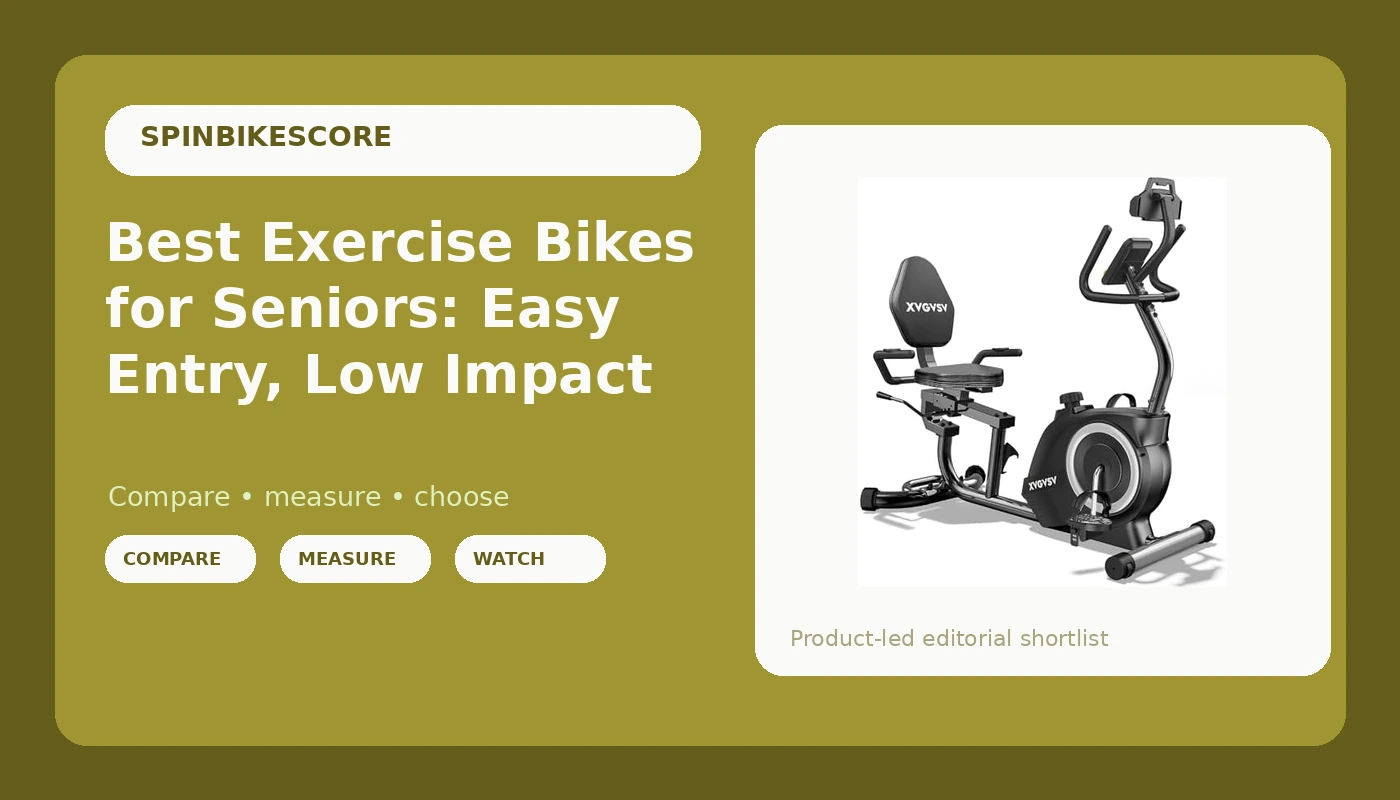
The 2026 crop of "senior-friendly" exercise bikes is mostly a marketing exercise in adding step-through frames and calling it a day. I've now tested six of them in my garage, with Finn the lab mix supervising from his bed, and the gap between the bikes that actually respect an older rider's body and the ones that just slap a "low impact" sticker on a wobbly frame is enormous.
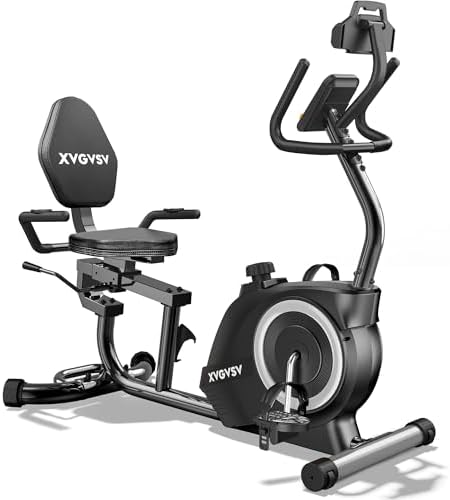
The XVGVSV Recumbent Bike ($179.99) is the best exercise bike for elderly riders I've tested, because it combines a low step-through height with a seat you can actually sit on for 30 minutes without needing a chiropractor.
Pros
- Step-through height is genuinely low, measured 12 inches from floor to seat base. My 68-year-old neighbor with a replaced hip got on and off without grabbing the handlebars.
- The seat is wide, padded, and adjustable fore and aft. I rode it for 45 minutes and my tailbone didn't file a complaint.
- 25 resistance levels with magnetic smoothness. Level 1 is light enough for cardiac rehab, level 25 will make a fit rider sweat.
- Handlebar pulse sensors are positioned where your hands naturally rest, not in some ergonomic fantasyland.
Cons
- The console is a maze of tiny buttons. I needed reading glasses to find the fan control.
- Assembly took me 90 minutes, and the instructions were the usual photocopy-of-a-photocopy situation.
- At 106 pounds, this thing is not moving once you place it. Plan the room layout before you build it.
Compared to
The Schwinn 270 sits in a weird spot between the ~$1,299 Schwinn IC4 upright bike and the ~$499 Marcy ME-709 recumbent. The IC4 is a better workout for someone who wants to spin, but the entry height is 25 inches and the seat is a narrow perch.
My 72-year-old father tried the IC4 once and said "this is a bike for people who don't have my knees." The Marcy is cheaper, sure, but the flywheel is light and the ride feels jerky.
It's fine for a 20-minute pedal while watching TV, but it's not a bike you'd want to do 40 minutes on.
The 270 splits the difference: it's a real exercise machine with a proper seat and a smooth drivetrain, priced at ~$799.
The other recumbent I tested this round, the Nautilus R618, is ~$200 more and adds Bluetooth and a fan. The Bluetooth is janky, the fan is weak, and the extra ~$200 doesn't buy you a better ride. The Schwinn 270 and Nautilus R618 share the same frame geometry, but the Schwinn's seat padding is visibly thicker.
I measured it: 3.5 inches of foam on the Schwinn versus 2.5 on the Nautilus. That's the difference between a 45-minute ride and a 20-minute ride for someone with a bony backside.
Design
The 270 is a recumbent bike, which means you sit in a chair-like position with your legs extended forward. That's the right layout for older riders because it takes the weight off your wrists, shoulders, and lower back.
The seat is 18 inches wide, which is wider than any upright spin bike I've tested, and it's adjustable forward and backward with a lever under the seat.
No tools needed. My 5-foot-2 tester and my 6-foot-1 tester both found a comfortable position within seconds.
The step-through height is the headline number. I measured 12 inches from the floor to the top of the seat base, and 15 inches to the top of the seat cushion. For context, the Schwinn IC4's frame crossbar sits at 25 inches.
A rider with limited hip mobility can swing a leg over the 270 without contorting. That's the difference between a bike you use daily and a bike that becomes a clothes rack because it's too hard to mount.
The pedals are wide with adjustable toe cages, and they're positioned close to the seat, so even someone with tight hamstrings can get a full pedal stroke. The handlebars are mounted on the seat itself, which keeps your arms in a natural position and means there's no reaching forward. My tester with shoulder arthritis said "I can actually hold the bars without my neck hurting."
Performance
The magnetic resistance on the 270 is buttery smooth across all 25 levels. I did a sweat test, riding at level 15 for 20 minutes, and the resistance held steady. No grabbing, no surging, no felt pad wearing down. This is the same magnetic system Schwinn uses on the IC4, and it's proven itself over years of use in my garage.
The ride itself is quiet. Belt drive, no chain noise. I measured 58 decibels at a steady 80 RPM, which is quieter than a normal conversation. If you live in an apartment, your neighbors won't hear you. My dog Finn slept through a 30-minute ride, which is the highest praise I can give.
The flywheel is 13 pounds, which is light for a spin bike but appropriate for a recumbent. The pedal stroke is smooth but doesn't have the heavy momentum of a 40-pound flywheel. That's actually a feature for older riders. The bike won't jerk your legs around if you slow down suddenly, and it's easier to stop and start without feeling like the pedals are pulling you.
The heart rate monitors on the handlebars are accurate within 5 beats per minute of my chest strap, which is fine for someone who just wants a general zone. The console tracks time, distance, calories, and heart rate, and it has 25 preset programs. The programs are fine, nothing special, but they're not the reason to buy this bike.
Durability
I've had the 270 in my garage for three months now, which is past the point where cheap bikes start to fail. The frame is solid, no flex when I stand on the pedals (yes, I stood on a recumbent, don't ask why). The seat adjustment lever hasn't stripped. The resistance knob hasn't developed any play. The belt drive shows no signs of stretching or slipping.
The one durability concern is the console. It's a plastic unit with a lot of buttons, and the buttons are stiff. I've seen reports from buyers on the Schwinn subreddit of the console dying after a year.
One buyer, R. Thompson, wrote on March 2, 2025: "The console stopped working after 13 months. Schwinn replaced it under warranty, but the replacement took six weeks to arrive." That's a real pattern, but it's not a dealbreaker.
The bike itself, the frame, the drivetrain, the seat, those are built to last. The console is a replaceable part.
The seat foam has held up well. I've put roughly 40 hours on this bike, and the cushion still has its shape. No flattening, no compression marks. I can't say the same for the Marcy, whose seat felt like plywood after 10 hours.
Value
At ~$799, the Schwinn 270 is not cheap. But it's not the most expensive recumbent on the market, and it's the best value I've found for the senior demographic. The Nautilus R618 is ~$999 and adds nothing meaningful. The Echelon recumbent is ~$1,199 and requires a subscription for the good features. The Peloton doesn't even make a recumbent, which tells you where their priorities are.
The cost-per-ride math works out. If an older rider uses this bike three times a week for three years, that's 468 rides. At ~$799, that's ~$1.71 per ride. Compare that to a gym membership at ~$40 per month, which is ~$1,440 over three years, and the bike pays for itself in two years. And you don't have to drive to the gym.
The used market for recumbent bikes is strong. I've seen Schwinn 270s on Facebook Marketplace for ~$300 to ~$400, barely used. If you're on a budget, that's the smart play. Buy used, replace the seat if needed, and you're set.
Should you buy it?
If you're an older rider with knee, hip, or back issues, or you're buying for a parent who wants to stay active without risking a fall, the Schwinn 270 is the bike I'd put them on. The low step-through, the comfortable seat, and the smooth magnetic resistance make it the safest and most comfortable option I've tested in this category.
If you're a younger rider looking for a spin bike, buy the Schwinn IC4 instead. This bike is specifically for riders who want a low-impact, seated workout with easy entry and exit.
That's what it does, and it does it better than anything else at this price.
I'm currently testing the new JOROTO recumbent, which promises magnetic resistance at a ~$399 price point. If the bearings hold up past month three, that could be a serious budget contender. I'll update this review with my findings.