Related: How to Stop a Spin Bike From Wobbling at Sprint Speed
I have taught more than 5,000 indoor cycling classes, first in studios and now out of a converted garage in Boise, and I have watched a lot of riders buy the wrong bike. The best budget exercise bikes for home are not the ones with the longest feature list. They are the ones that hold still when you stand up, whose resistance stays smooth from easy spin to standing climb, and whose seat you can tolerate for 45 minutes.
The three bikes here, the JOROTO Belt Drive, the YOSUDA, and the MERACH, solve that problem in three different ways. One uses a belt drive. Two use magnetic friction. All three are built for a house, not a studio, which means smaller footprints, lighter frames, and noise levels that will not end a marriage.
My rule for anyone shopping: a cheap bike that fits you beats an expensive bike that does not. Fit and stability come first, apps and screens come last. Here is how the three compare, and what I would check before handing any of them to a rider.
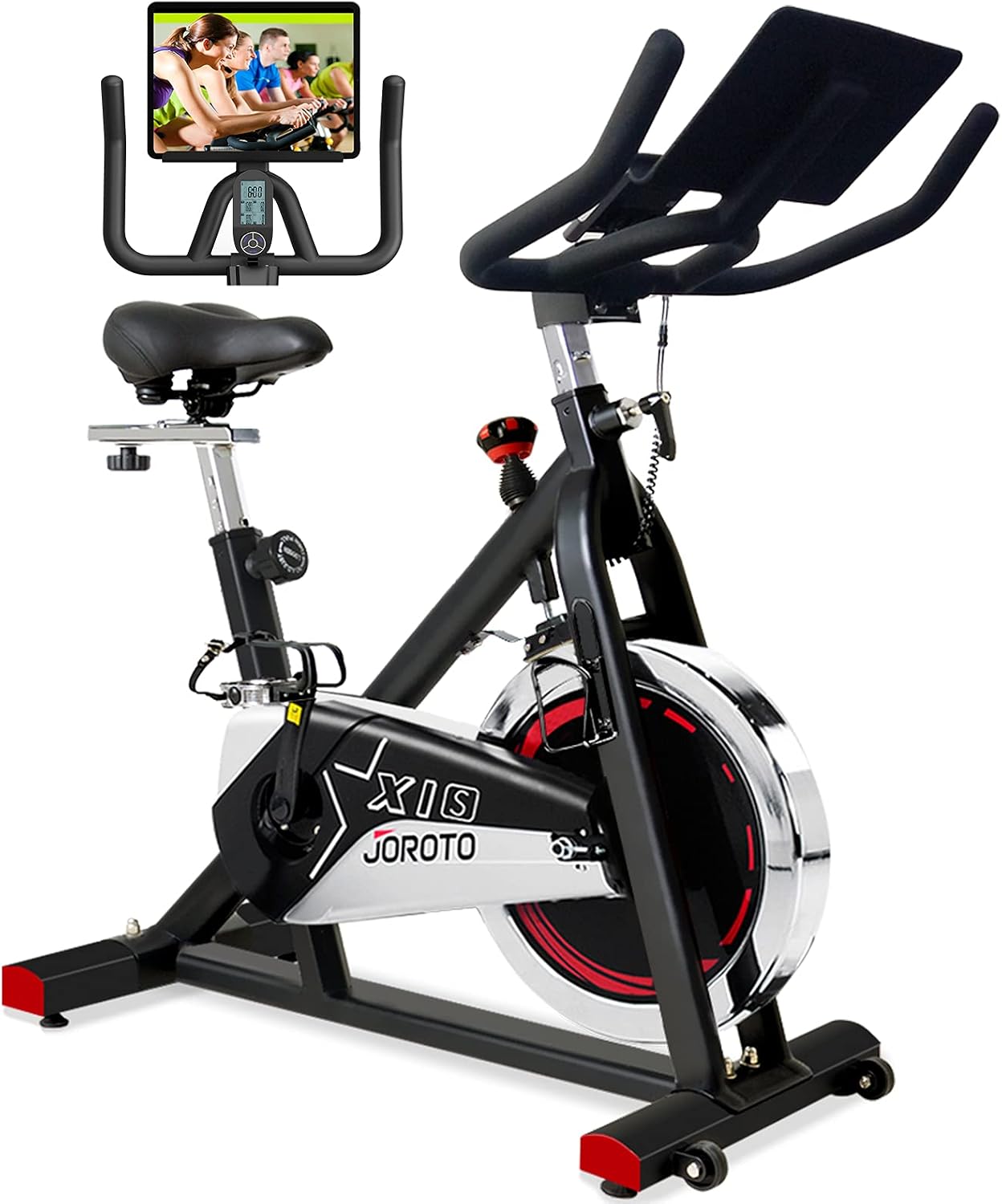
Best Overall: JOROTO Belt Drive Exercise Bike (updated X1S)
This is the bike I recommend first to riders who tell me they want to buy once and stop thinking about it. The reason is in the name. A belt drive replaces the chain that most indoor bikes use to turn the flywheel, and a belt does not need oil, does not stretch into a rattle, and does not leave a grease stripe on your carpet. Chain maintenance is the chore nobody does. A belt removes it from your life entirely.
The X1S is also shaped like the bikes I teach on. The frame puts you in a forward lean over the pedals rather than the reclined posture of a comfort bike, and that matters more than most shoppers realize. When your hips sit behind the pedals, your knees take the load at an angle they were not built for. When you are stacked over them, a 45-minute ride feels like work instead of punishment.
Two things to check when it arrives. First, the resistance mechanism is separate from the belt, so run it from the lightest setting to the heaviest and feel for a smooth ramp the whole way. If it grabs or slips in the middle of the range, that is a return, not a fix. Second, do the standing test early. Clip in or strap in, stand up at sprint resistance, and see if the bike walks across the floor. If it does, the leveling feet need adjusting before you blame the frame.
The saddle is the one part I would plan to upgrade. Nearly every bike in this class ships with a seat that feels fine for ten minutes and like a brick by mile 20, and swapping it is the cheapest comfort upgrade you can make.
Best Value: YOSUDA Exercise Bike
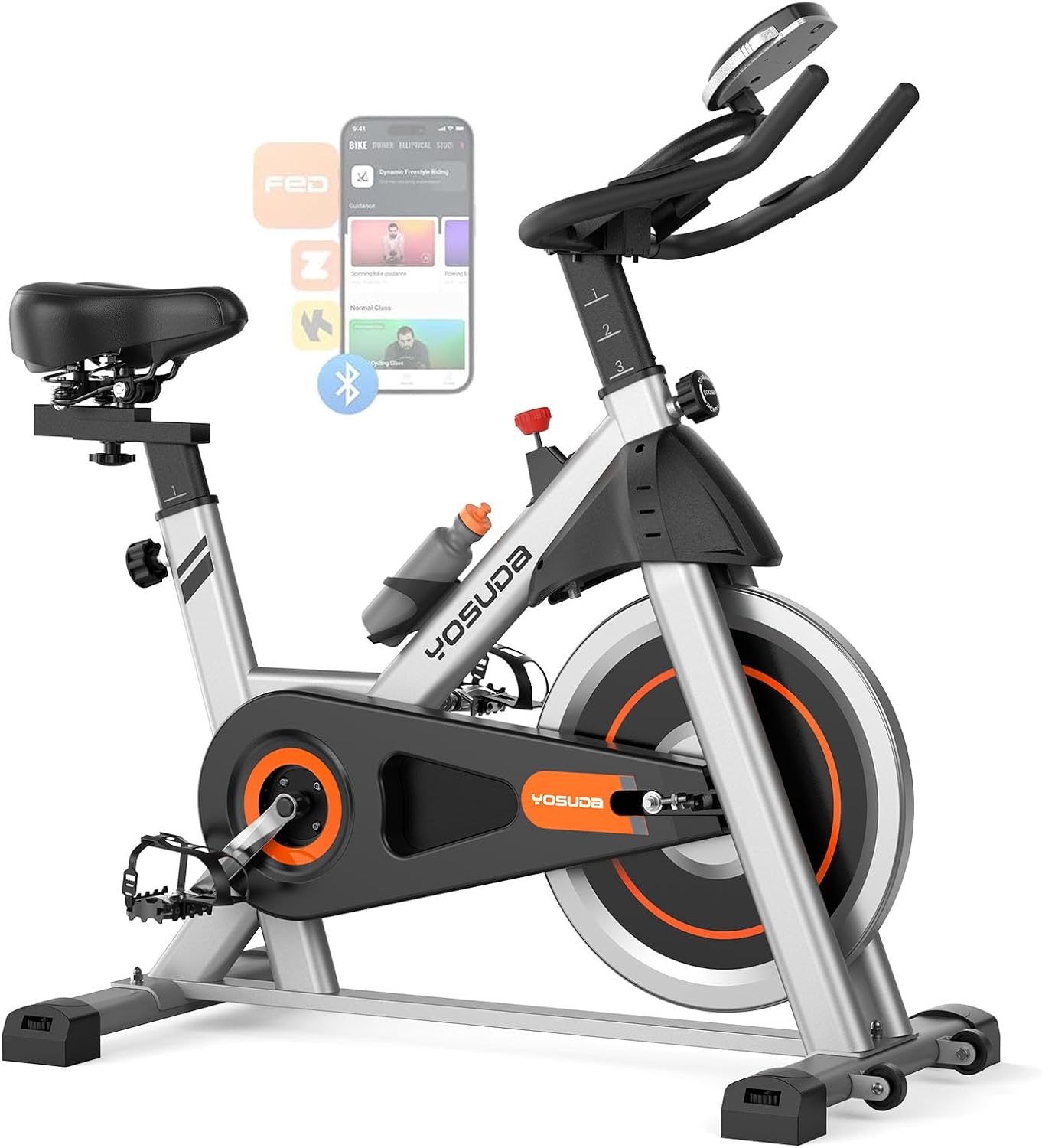
The YOSUDA is the bike I hand to the rider who is not sure they will stick with it. It uses magnetic friction resistance, which is the setup I prefer over felt pads for one simple reason: magnets do not wear out. A felt pad presses against the flywheel, and every one of those presses shaves a little material off. Ride daily and you will be replacing pads and cleaning black dust off the floor within a year. Magnets brake against the wheel without touching it, so the resistance on month twelve feels like the resistance on day one.
It ships with app training, and for a lot of riders that is the difference between riding twice a week and riding twice a month. Riding alone in a spare room is boring. Riders who quit almost never quit because the bike was bad. They quit because they had no idea what to do for 40 minutes. A screen with a program on it solves that.
Where I would spend my attention: the pedals. Plastic toe cages are the first thing to fail on budget bikes, and I have watched a cage snap mid-class, which is not something you want at speed. Check them in the first month. If they flex, swap them. The seat gets the same note I give every bike at this price, which is to budget for a replacement.
Best for Guided Training: MERACH Exercise Bike
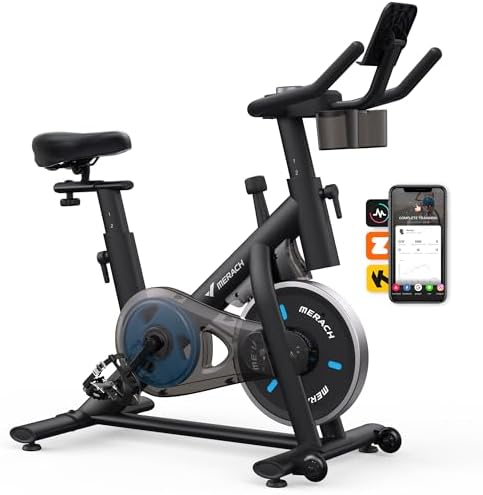
The MERACH lands in the same category as the YOSUDA, magnetic friction with an app, and the honest answer is that the two are close enough that the deciding factor is not the hardware. It is which one you will actually use. If you already have a tablet and a training app you like, the bike is just the thing you mount it on, and you can let price and fit decide.
What I like about magnetic resistance on a bike like this is how smoothly it ramps. Felt pads tend to feel like an on and off switch: easy, easy, easy, suddenly hard. A good magnetic system lets you add a quarter turn and feel it, which is how you pace a climb instead of surviving one. When the bike arrives, test that ramp at low cadence and at sprint cadence, because a resistance system can feel smooth when you are crawling and crunchy when you are flying.
The app is the real feature here, and I want to be clear about what an app can and cannot do. It cannot pedal for you, it cannot fix a seat that is too low, and it cannot make a wobbly frame stable. What it can do is tell you when to stand, when to sit, and when to hold a zone, which is exactly the coaching that most people riding alone are missing.
How I test a bike before I recommend it
I keep a wrench set by the door because every bike in my garage has needed one, and I do not recommend anything I have not put through the same routine.
It starts with distance. A bike that feels fine for 20 minutes can fall apart at 50 miles of weekly riding, so that is the minimum I put on a frame before I form an opinion. The second week usually tells the truth: that is when the seat rails start to complain, the pedals start to click, and the resistance knob either holds its setting or drifts.
Then the sweat test. Forty-five minutes at max effort, then I look at what the frame did. Sweat is salt water, and salt water eats cheap paint and cheap steel. A bike that is already showing rust freckles at the welds after a month of real riding is a bike that will look terrible in two years.
Then the standing sprint. Full resistance, out of the saddle, drive hard. This is the test that separates bikes. A bike that wobbles when you are seated is annoying. A bike that wobbles when you are standing at sprint resistance with your whole body weight shifting side to side is a safety problem, and I will pull a bike out of rotation for it.
Month three is the bearing check. Spin the pedals and the flywheel with the bike off and listen. A healthy bike is close to silent. A grinding noise means the bearings are dry or cheap, and that is the point where a bargain stops being a bargain.
And the last question, the one that matters most: would I teach a class on it? If I would not put 20 riders through a 45-minute class on a frame, I do not tell one rider to buy it.
What the three bikes have in common, and where they differ
All three of these are designed for a house. None of them carries the commercial heft of the Keiser I teach on, and that is fine, because a commercial bike weighs a small car's worth and costs like one. What matters is whether the design choices hold up under a real rider.
Resistance is the biggest fork in the road. The YOSUDA and the MERACH run magnetic friction, which never wears out and stays consistent over years. The JOROTO's belt drive addresses a different system entirely, the drive from your cranks to the flywheel, and removes chain noise and chain maintenance. Neither approach is automatically better. A well-built belt bike with a poor resistance unit is worse than a simple magnetic bike done right.
Flywheel weight is the number everyone quotes and the one I trust least on its own. Weight smooths your pedal stroke, which is real. But a heavy flywheel bolted to a flexy frame is a heavy flywheel you cannot ride out of the saddle. I would take a lighter wheel on a stiff frame every time.
The seated position matters as much as any spec. Q-factor is the width between your pedals, and a wide one will have your knees complaining by minute 20. You cannot read this off a spec sheet. You find it by riding.
Seats and pedals are the two parts that fail first on almost every affordable bike, and they are also the two cheapest to replace. Factor that into what you spend, and be pleasantly surprised if you do not need to.
Spin bike reference table
This is the table I keep in my notes when riders ask me to compare these three. Use the drive and resistance column to narrow your list, and the last question you should ask is which one you will actually climb onto on a Tuesday night.
| Bike | Drive and resistance | Best for | Where to buy |
|---|---|---|---|
 Visit on Amazon → Visit on Amazon →JOROTO Belt Drive Exercise Bike (updated X1S) |
Belt drive, no chain to oil or tension | Riders who want a spin-bike silhouette and the least upkeep | Check current Amazon price |
 Visit on Amazon → Visit on Amazon →YOSUDA Exercise Bike |
Magnetic friction, app training included | A first bike and a first training plan | Check current Amazon price |
 Visit on Amazon → Visit on Amazon →MERACH Exercise Bike |
Magnetic friction, app included | Riders who need a coach on a screen | Check current Amazon price |
| Replacement saddle | Not included | Every bike in this price band | Buy separately |
| Replacement pedals | Not included | Any bike with plastic toe cages | Buy separately |
| Floor mat | Not included | Hardwood and laminate floors | Buy separately |
Belt drive or magnetic friction?
These are two different systems and shoppers confuse them constantly. Belt drive describes how your legs turn the flywheel. Magnetic friction describes how the bike creates resistance. The JOROTO answers the first question with a belt. The YOSUDA and MERACH answer the second with magnets.
If quiet matters and you hate maintenance, a belt is a genuine upgrade, because a chain rattles and a belt does not. If you ride daily and want the resistance to feel the same in year two as it did in week one, magnets are the answer. Ideally you get both on the same bike. At this end of the market you usually get one, so pick the one that solves your actual problem.
The app question
Every budget bike now advertises an app, and I want to be honest about the value. An app is worth paying for if it is the reason you get on the bike. It is worth nothing if you already follow your own intervals or stream classes from another service.
What I will not accept is a bike that only works with its app, or a subscription that turns basic resistance adjustment into a paywall. The bikes here let you ride without one, which is how it should be.
Should you buy the JOROTO Belt Drive Exercise Bike?
Yes, if you want the bike that asks the least of you. The belt drive means no chain oil, no chain noise, and no grease on the floor, and the frame is shaped like the bikes I teach on, which puts your hips over the pedals where they belong. Plan on a new saddle, and run the resistance range the day it arrives.
The rider who will love this bike is the one who wants to set it up once and ride it five days a week without thinking about it.
Should you buy the YOSUDA Exercise Bike?
Yes, if you want magnetic resistance and guided training at the lowest cost of the three. Magnets do not wear out, so the resistance you feel in month one is the resistance you feel in year two, and the included app training solves the real problem, which is not knowing what to do for 40 minutes.
Budget for a seat and keep an eye on the pedal cages in the first month. Those are the two parts that let down almost every bike at this price, and upgrading them costs less than a month of studio classes.
Should you buy the MERACH Exercise Bike?
Yes, if a screen with a program on it is what gets you on the bike. Magnetic resistance gives you the smooth ramp you need to pace a climb instead of surviving one, and the app gives you the structure most people riding alone never build for themselves.
If you already have a training app you love, this and the YOSUDA come down to which one fits you better. If you do not, buy the one whose app you will actually open, because that is the difference between a bike you ride and a bike you store.