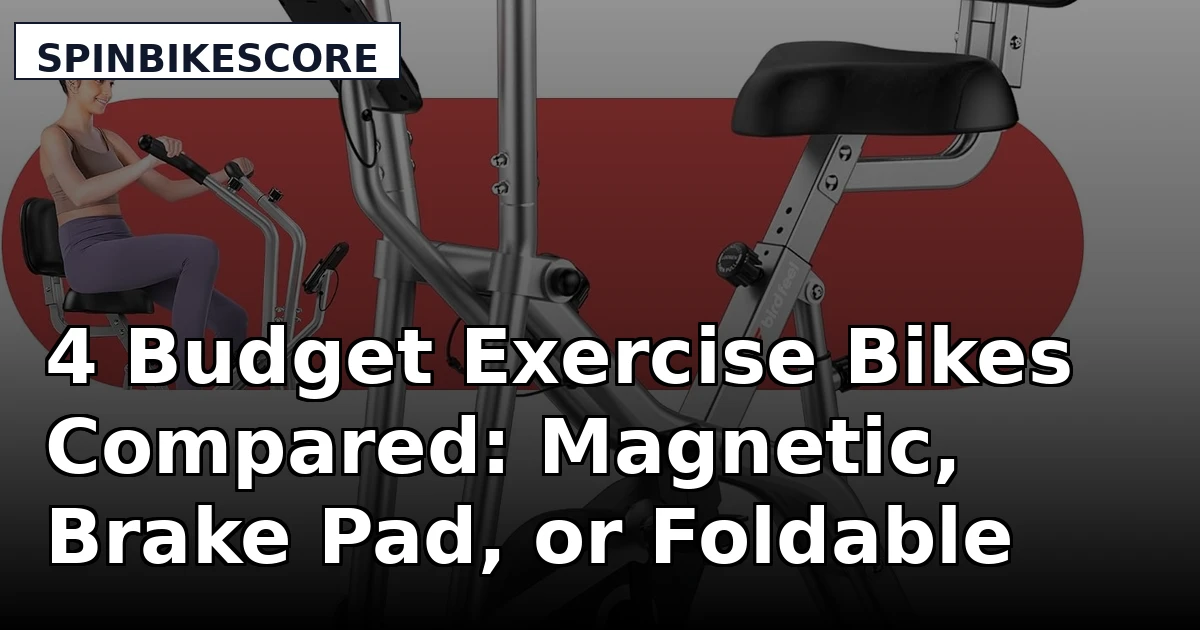
I have taught indoor cycling for 14 years, first in a studio on commercial bikes that cost more than my car, and now out of a converted garage in Boise. In that time the question my riders ask has changed. It used to be "which spin bike should I buy?" Now it is "is the cheap one on Amazon good enough?" That is the question this budget exercise bikes comparison tries to answer, and the honest reply is that it depends on three things: how the resistance works, whether the frame actually fits your body, and whether you will still want to sit on that seat in week three.
For most riders, the 32-level magnetic indoor cycling bike is the pick, because it has the widest resistance range in this group, a belt drive with no pad to wear out, and a published fit range that covers riders from 5'1" to 5'11" at a 300 pound capacity. If you need to fold a bike into a closet, or you want a stride that is gentler on your knees, that answer changes, and I will get to both.
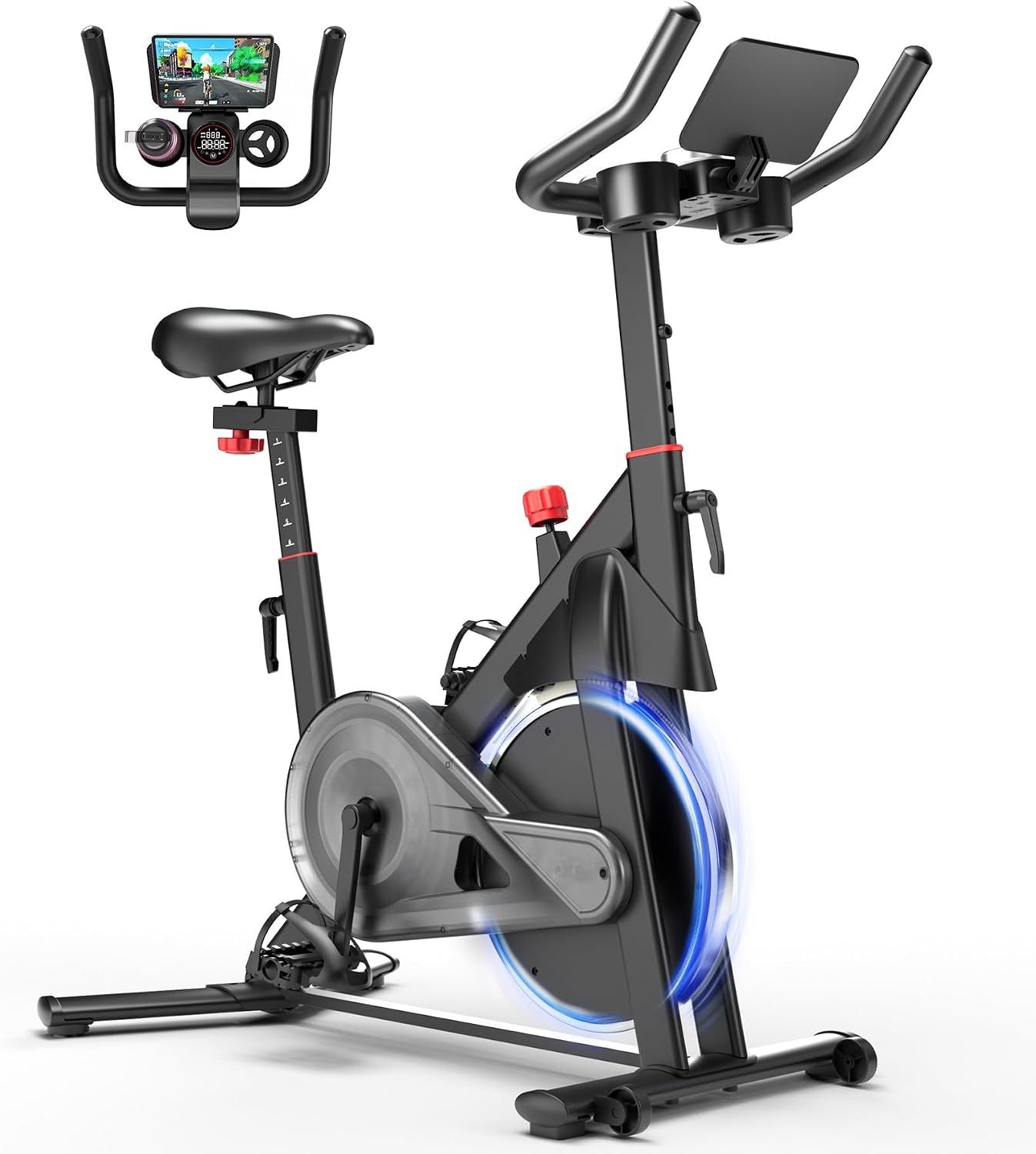
Indoor Cycling Bike, 32-Level Magnetic Resistance with Adjustable Seat and Handlebars, Silent Belt Drive
The widest resistance range here, a belt drive instead of a wear part, adjustable seat and handlebars, and a stated fit range from 5'1" to 5'11" with a 300 pound capacity
Heaviest and bulkiest of the four, no folding, no app, and it is still a spin bike posture whether your back wants that or not
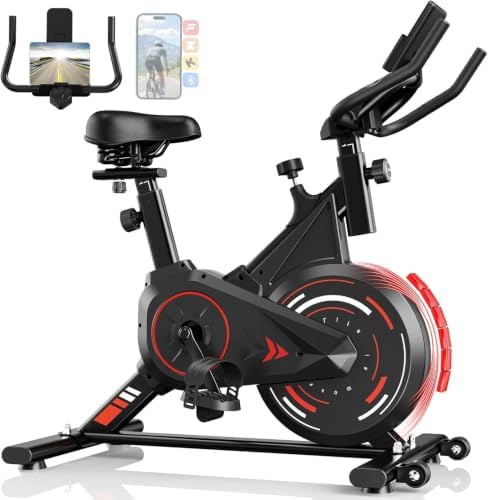
Exercise Bike with APP, Ultra-Silent Flywheel
App connectivity for riders who want a class on screen, and a flywheel built around quiet operation rather than noise
The app is only as good as the phone you prop up, quiet flywheels still need assembly and floor space, and the fit range is not spelled out the way the first bike spells it out
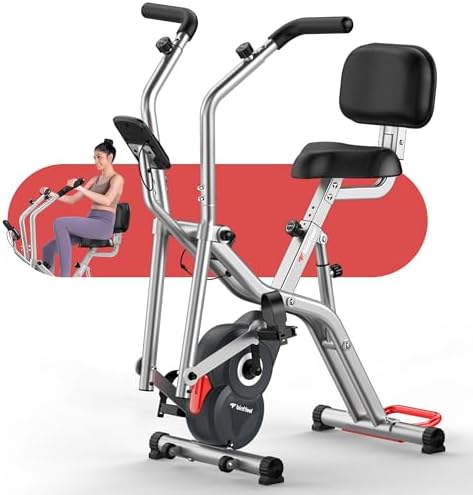
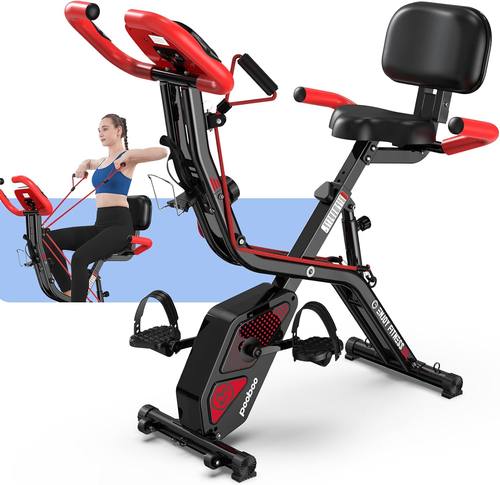
Foldable Elliptical Exercise Bike, 8-Level Magnetic
It folds, which matters more than any spec if your living room is also your gym, and the elliptical stride is genuinely easier on knees and hips
Only 8 resistance levels, and an elliptical stride is a different movement than pedaling a spin bike, so it will not feel like the class you remember
CURSOR FITNESS Exercise Bike with Brake Pad
The simplest, cheapest way into a stationary bike, and friction resistance is easy to understand and easy to adjust
A brake pad is a wear item, it grabs differently as it heats up, and it will need attention long before a magnetic system does
Prices and availability were captured from Amazon Creators API and may change.
What actually separates these four bikes
Spec sheets make every bike look the same. Resistance type, level count, and frame geometry are what you actually feel at mile ten, so that is what I compare.
Resistance mechanism. Two of these bikes use magnets, one pairs magnets with app connectivity, and one uses a brake pad. Magnetic resistance is smoother across the whole range and it does not wear out. A brake pad works, and there is nothing wrong with it if the bike is built right, but a pad is a consumable. It glazes, it needs tension adjustment, and the resistance feel changes as it warms up during a hard session. If you ride four or five days a week, that difference shows up within a year.
Level count. Eight levels and 32 levels are not the same bike with different labels. Eight levels means each click is a big jump, and the jump between level five and level six can be the difference between a sustainable climb and a grind. Thirty-two levels means you can find the resistance you want instead of the resistance you are given. That matters most for interval work, where you are changing resistance every 30 seconds.
Frame and fit. Only one of these four publishes a fit range and a weight capacity, and that is the 5'1" to 5'11", 300 pound indoor cycling bike. Everything else in this group asks you to guess. My rule is simple: a cheap bike that fits you beats an expensive bike that does not, because a bike you cannot set up correctly is a bike you will not ride.
The indoor cycling bike: the one I would buy
The 32-level magnetic bike is the closest thing here to a studio bike, and it is the one I would put in a garage without hesitation. Thirty-two levels of magnetic resistance give you the fine control you need for a real interval session, and the belt drive means the bike stays quiet and you never replace a pad.
The details I care about are the ones the listing actually states: adjustable seat, adjustable handlebars, a fit range from 5'1" to 5'11", and a 300 pound capacity. Adjustable handlebars are the piece most budget bikes skip, and it is the piece that decides whether your shoulders and lower back survive a 45 minute ride. The stated weight capacity is also the number that tells you whether the frame will stay planted when you stand up at high resistance.
What you give up is portability. This is the heaviest and least movable option in the group, and there is no app, no screen, and no subscription pitch. For me that is a feature. A bike that does one thing well and does not ask for a monthly fee is a bike I can recommend without a caveat.
The app bike: quiet flywheel, connected screen
The flywheel bike with app support is the middle path. It pairs an ultra-silent flywheel with app connectivity, which is exactly what a rider coming from studio classes usually wants: a screen in front of them, an instructor calling the cadence, and a bike quiet enough that the neighbors do not learn your schedule.
I have a bias here, and I will own it. I track every ride on a spreadsheet and I have never once needed a subscription to make me pedal harder. But I also teach classes, so I know the value of someone telling you to add resistance. If the app is what gets you on the bike on a Tuesday night when you would rather sit down, the app is worth it.
What I would check before buying is fit. The listing leads with the flywheel and the app, not with a rider height range or a weight capacity, so if you are at either end of the size spectrum, measure before you commit. A quiet bike that puts your knees at a bad angle is still a bad bike.
The foldable elliptical: the one for small rooms and sore knees
The foldable elliptical bike is the odd one out, and it is also the one I recommend most often to riders over 50 or anyone with a knee that has opinions. The stride is different from pedaling a spin bike: less hip flexion, less load on the joint at the top of the stroke, and a movement pattern that a lot of people can tolerate for 40 minutes when a bike seat is out of the question.
Eight levels of magnetic resistance is the limitation. It is smooth and it will not wear out, but the jumps between levels are wide, and if you like precise interval work you will notice. For steady-state cardio, walking-pace effort, and daily movement, eight levels is plenty.
The folding frame is the real feature. If your bike has to live behind a couch, this is the only one in the group that solves that problem, and a bike that is easy to set up is a bike that gets used. The trade-off is that a folding joint is one more mechanism, so treat the latch with respect and check it the way you would check anything that holds your body weight.
The brake pad bike: the cheapest way in
The CURSOR FITNESS bike with a brake pad is the entry point. Friction resistance, a simple frame, and a design that has been around since the 1980s. Nothing about it is fancy, and that is not automatically a criticism. Felt pad resistance is fine if the bike is built right, and plenty of riders have gotten strong on exactly this setup.
Here is what you need to know going in. A brake pad wears. It will need adjustment, then replacement, and the resistance feel will change as it heats up during a long climb. On the cheaper bikes in this category, that pad is often the first thing to fail, which is why I tell riders to budget for a replacement pad the same way they budget for a replacement seat.
If you ride twice a week and you want to spend as little as possible to find out whether home cardio is for you, this bike does that job. If you already know you will ride daily, put the money toward a magnetic bike instead and skip the maintenance.
The trade-offs the listings leave out
The seat. On nearly every budget bike, the saddle is the first thing to replace. A hard, narrow, flat seat is fine for a 20 minute spin and miserable at minute 40. Factor a replacement into whatever you spend, and if you are new to riding, give yourself two weeks before you decide the bike is the problem rather than the seat.
The pedals. Plastic cages on cheap pedals are a pet peeve of mine. They flex, they crack, and they do not hold a shoe. If the bike you buy comes with them, plan on swapping to a pedal with a real cage or a clip-in system.
Noise claims. Every listing says quiet. What actually matters is the drive system. A belt drive with magnetic resistance is the combination that stays quiet over time, because there is no pad rubbing on a flywheel and no chain to stretch.
Assembly and floor space. All four of these arrive in a box. None of them are hard to build, but a folding bike and a spin bike are not the same project, and a spin bike takes up a permanent footprint that you should measure before it arrives.
Apps and subscriptions. One bike here has app support built in. That is a feature only if you will use it, and it is a cost only if the app requires a subscription. Ask yourself honestly which one it is.
How I would decide in one sitting
Ask yourself three questions, in order.
First, do I have a permanent spot for a bike? If yes, buy the 32-level magnetic indoor cycling bike and do not look back. It is the most bike for the money in this group, it fits the widest range of riders, and there is nothing on it to replace except the seat.
Second, do I need to put it away? If yes, the foldable elliptical is the only real answer here, and the gentler stride is a bonus rather than a compromise.
Third, do I need a screen to show up? If yes, the app bike earns its place. If the honest answer is no, save the money.
The one I would skip is the brake pad bike, but only for a rider who already knows they will train four or five days a week. For a beginner testing the water, it is a legitimate, low-cost first step.
What I'm testing next
I have a standing-sprint stability test and a bearing check on the calendar for this batch, and the thing I am watching most closely is how each frame behaves at full resistance when you come out of the saddle. That is where cheap bikes separate: a bike that stays planted is a bike you can train on, and a bike that wobbles is a bike that scares you out of the hardest part of the workout.
The other thing on my bench is the seat question. I want to know which of these four saddles survives a 45 minute ride without a rider shifting every two minutes, because that single detail decides whether a budget bike gets ridden or gets folded into a corner.
Until then, the short version stands. Buy the bike that fits you, prefer magnets over pads, and count the seat into the price. That is the whole test.