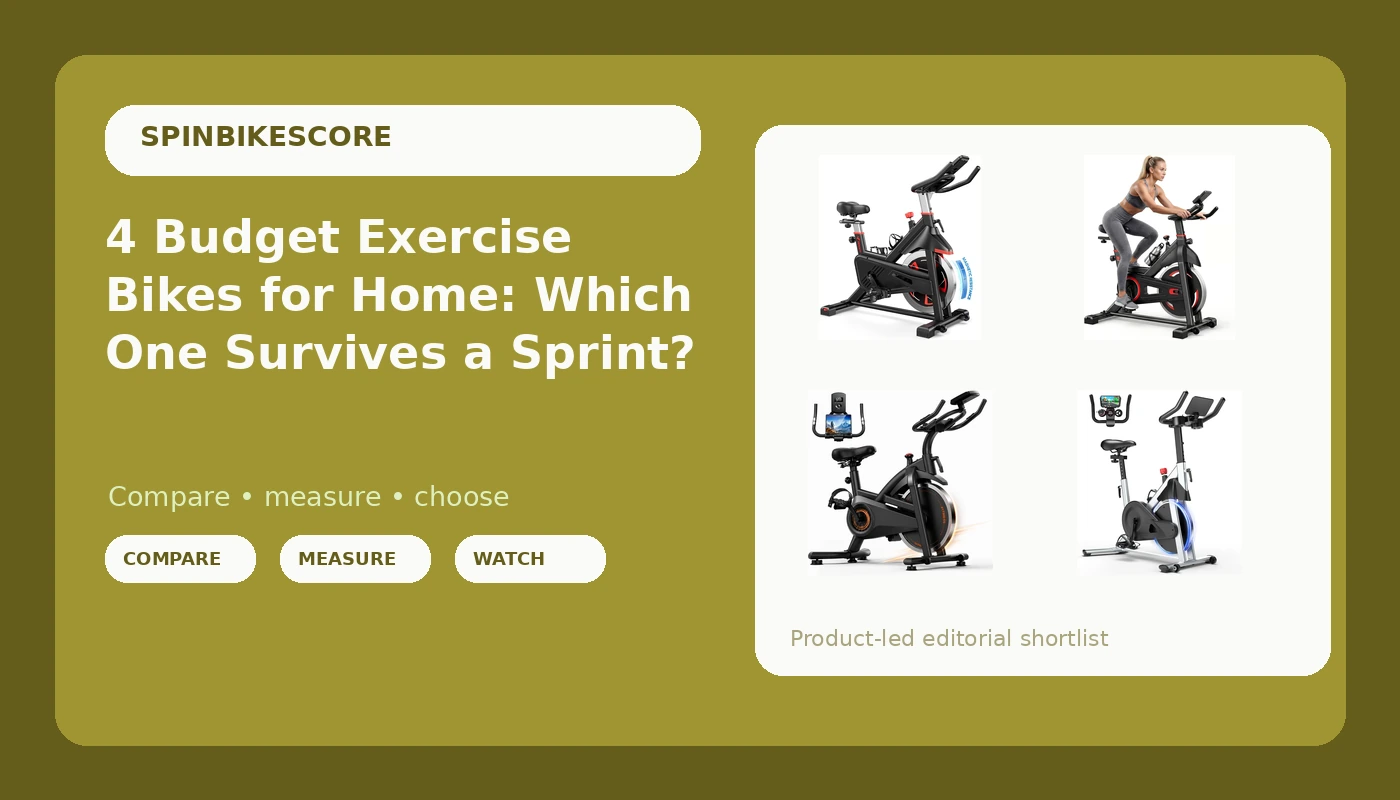
Every October I get the same message from riders in my Boise classes: they want to keep their legs turning through the cold months, they have a corner of a garage and a real budget, and they do not want to spend commercial-bike money on something they might abandon by December. So I went through this season's crop of budget exercise bikes for home, the ones that show up on Amazon with big claims and small frames, and sorted out which are worth the floor space. Two of these bikes run magnetic resistance, one presses a brake pad against the flywheel, and one leans on an app to make up for what the hardware does not have. The gap between them is not as wide as the marketing suggests, but it is real, and it shows up in the two places that matter most: under your hands when you stand up to sprint, and under your sit bones at mile twenty.
The bike I would put in my own garage is the MERACH Magnetic Exercise Bike, because a heavy duty frame plus magnetic resistance are the two things that decide whether you still like a bike in month three. The 32-level magnetic bike is the better fit for most riders and the one I would hand to a first-timer. The other two are situational, and I will tell you exactly which situations.
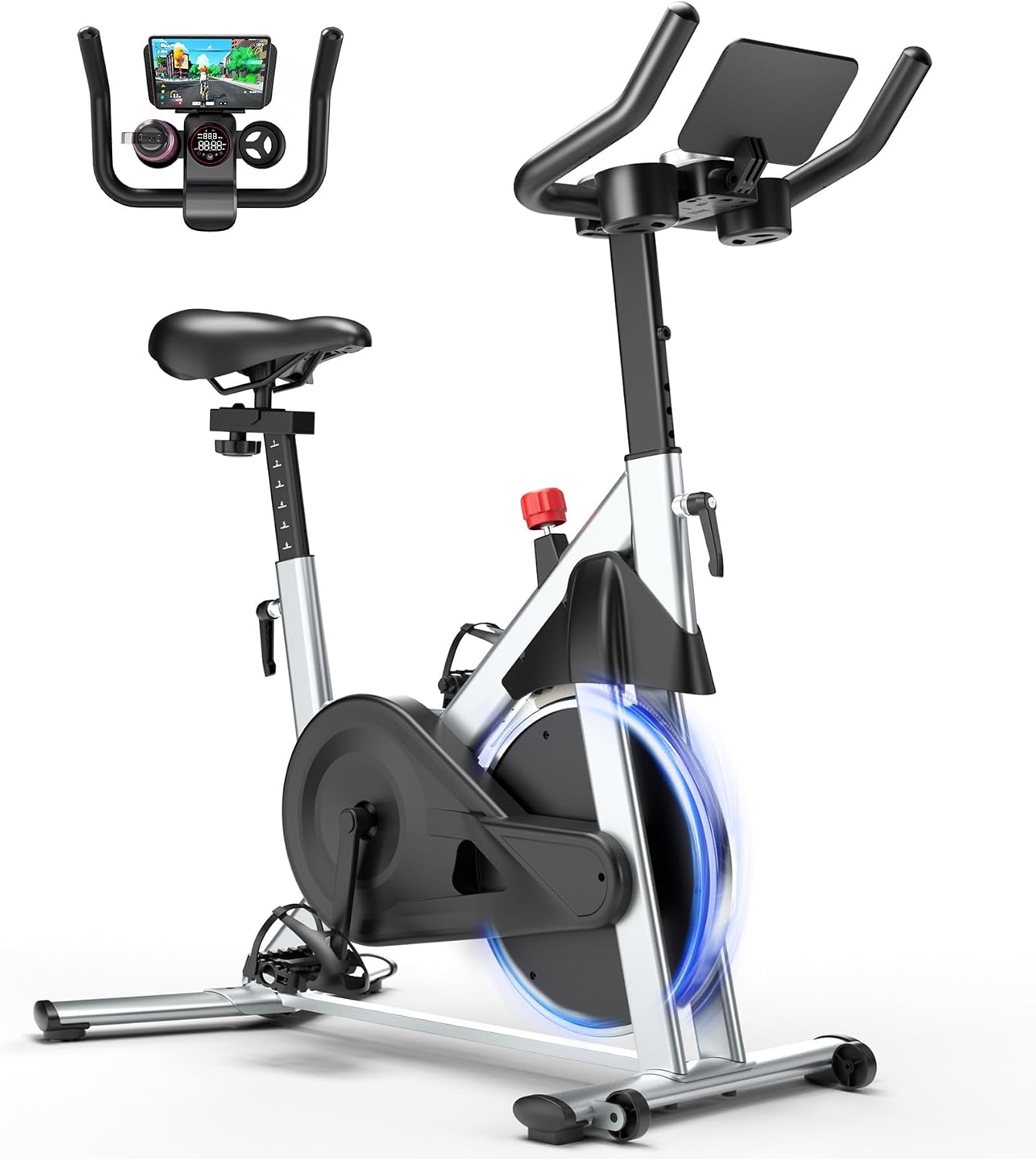
Indoor Cycling Bike, 32-Level Magnetic Resistance
32 resistance levels, silent belt drive, adjustable seat and handlebars, 300 lb capacity, stated fit range of 5'1" to 5'11"
Fit range stops at 5'11", so taller riders are out, and no app or console is mentioned
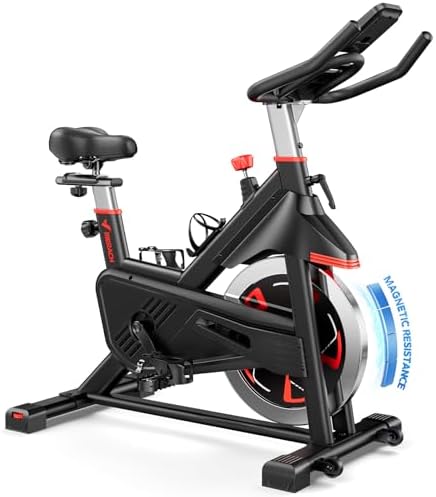
MERACH Magnetic Exercise Bike, Heavy Duty Stationary Bike for Home Gym
Heavy duty frame with magnetic resistance, the steadiest platform here for standing sprints
No published fit range or weight capacity in the listing, and the biggest footprint of the four
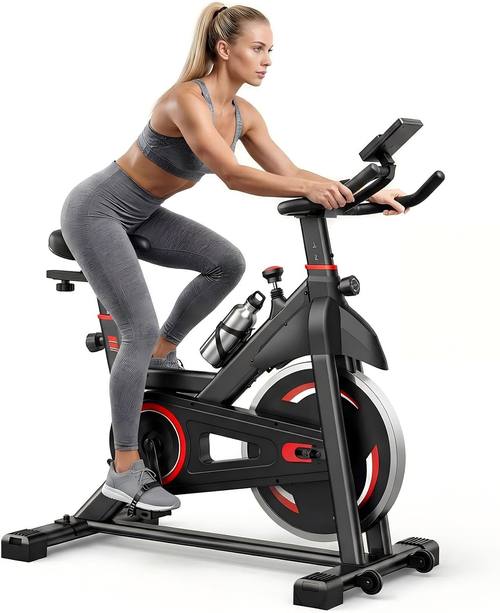
NEWBULIG Exercise Bike with APP, Stationary Bike for Home
App connectivity, adjustable height and resistance, low noise claim, easy assembly, 265 lb capacity
Lowest weight ceiling on this list and no named drive system or resistance mechanism
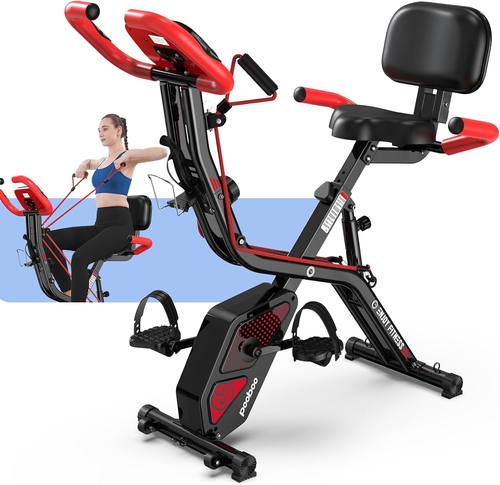
CURSOR FITNESS Exercise Bike with Brake Pad
Brake pad resistance gives an immediate, direct feel, and the simplest mechanism to service
Pads wear, need periodic adjustment and replacement, and get louder as they glaze
Prices and availability were captured from Amazon Creators API and may change.
How I sort budget bikes before I trust them
Four questions, in this order.
Does it stay planted when you leave the saddle? A wobbly bike at sprint resistance is a safety hazard, not an inconvenience. Frame weight and where the stabilizers sit decide this. A heavy duty frame is not vanity, it is the difference between a hard effort and a tip-over.
Is resistance smooth across the whole range, or does it jump from easy to impossible in the last two clicks? Magnetic resistance tends to win here because magnets do not wear, and more levels give you more room between the gears.
Will the seat and pedals survive month three? The seat is the first thing to replace on most budget bikes, so budget for it. Pedals with plastic cages are the other early casualty, especially if you ride in cycling shoes or push hard out of the saddle.
Does it fit you? A bike that fits beats a bike with better specs every single time. If you are 5'0" or 6'2", a listed fit range is not a suggestion, it is a hard limit.
I also do not trust a size claim without a rider on the edge of the range, and I do not trust a "low noise" claim without knowing what is making the noise. A belt drive and a felt pad pressed against a spinning flywheel are two completely different sound stories, and you can hear the difference from the next room.
Magnetic resistance versus a brake pad
Magnetic resistance uses magnets that move closer to or further from the flywheel. Nothing touches, so nothing wears out, and the resistance stays consistent for years. Two bikes on this list go that route, and it is not a coincidence that they are the two I would recommend first.
A brake pad works like a rim brake on a road bike: felt or leather presses against the flywheel. It is simple, it is inexpensive to manufacture, and it gives you a very direct, immediate feel. It is also a wear item. Ride daily and you will be adjusting that pad, and eventually replacing it, and a worn pad gets grabby and loud before it gets smooth again.
Then there is the third category: "adjustable resistance" with no mechanism named. That usually means a pad, a tension strap, or a magnetic system the brand did not think was worth mentioning. Not automatically bad, but you should know what you are buying.
The 32-level magnetic bike: the best all-around fit
This is the one I would hand to most people. The spec list explains why: 32 resistance levels, magnetic resistance, a silent belt drive, an adjustable seat, and adjustable handlebars, with a stated fit range of 5'1" to 5'11" and a 300 lb capacity. That combination checks nearly every box that matters for a home bike, and the belt drive means no chain oil and no drivetrain rattle.
Thirty-two levels is more useful than it sounds. On a bike with eight or ten levels, the jump between climbing and all-out is one click, and you end up riding the same two settings forever. With 32, you can find the gear that lets you hold 90 rpm for twenty minutes and then a gear that makes a 30-second push hurt the way it should.
The fit range is the thing to be honest with yourself about. It covers most adults, but if you are taller than 5'11" or shorter than 5'1", this is not your bike, no matter how good the resistance is. The 300 lb capacity is the highest ceiling on this list and worth noting if you are a bigger rider, since most budget frames top out lower.
The heavy duty pick: MERACH Magnetic Exercise Bike
The MERACH is the bike I keep coming back to for riders who want to sprint. It is built as a heavy duty home gym machine with magnetic resistance, and heavy duty is the operative phrase. When you stand at high resistance and rock the bike side to side, the frame has to absorb that energy. Light frames flex, the flex becomes a wobble, and a wobble at sprint speed is how people end up on the floor.
Magnetic resistance on a heavy frame is the right combination: smooth across the range, no pad to replace, no felt smell in a closed garage. If you are coming from studio bikes, this is the one that will feel closest to what you ride in class, because studios run heavy frames with magnetic resistance for exactly these reasons.
What I cannot tell you from the listing is the seat, and almost no budget bike ships with a seat I would ride 50 minutes on. Assume a replacement is part of the purchase on all four of these. Factor that in and the MERACH is still the pick, and it is the one I would buy if I were riding it four days a week.
The app bike: NEWBULIG Exercise Bike
The NEWBULIG is the only bike here that leads with connectivity, and that tells you where the money went. It is a home workout bike aimed at adults and seniors, with app support, adjustable height and resistance, a low noise claim, a 265 lb weight capacity, and an easy assembly story.
The app is genuinely useful for one kind of rider: the person who needs a screen and a plan to get on the bike at all. If you have ever bought home fitness equipment and used it four times, the app is not a gimmick, it is the feature that keeps you pedaling. I have watched riders who hate group classes turn into daily riders because a program told them what to do for thirty minutes.
The trade-off is the frame. The 265 lb capacity is the lowest ceiling on this list, and "low noise" without a named drive system means you should expect pad-style or tension resistance rather than a belt drive. That is fine for steady-state riding at moderate resistance. It is less fine if you plan to stand and sprint every session. The easy assembly is a real point in its favor, though, because a bike you can put together in an evening is a bike you start riding this week instead of next month.
The brake pad bike: CURSOR FITNESS
The CURSOR FITNESS bike is the simplest machine here, and it says so right in the name: brake pad resistance. No magnets, no belt, just a pad against the flywheel.
I have taught on pad bikes for years and there is a lot to like. The resistance feels immediate and analog, the way a road brake lever feels. There is nothing electronic to fail. And the mechanism is simple enough that almost any problem is a five-minute adjustment with the wrench you keep by the door.
The catch is maintenance and noise. A pad wears, and as it wears, the resistance at a given setting changes, so the gear you loved in January is not the gear you have in June. Pads also glaze and get loud, and a glazed pad feels grabby at the bottom of the pedal stroke. If you ride three times a week, plan on checking the pad monthly and replacing it periodically. That is not a dealbreaker, but it is a chore, and it is the reason I rank magnetic resistance ahead of pads for anyone riding daily.
What the spec sheets leave out
Four things I check on any budget bike, and none of them appear in the bullet points.
The seat. Replace it. A seat that feels like a brick at mile twenty is why bikes end up on the resale market. Measure your sit bones, buy a saddle that matches, and consider a padded cover for the first month while you adapt.
The pedals. Plastic cages are a warning sign. If the pedals take standard threads, swapping them for a pair with proper straps or clipless-compatible pedals is cheap and changes how the bike feels out of the saddle.
The Q-factor. That is the width between your pedals. A wide stance is fine for ten minutes and annoying for forty, and it is the one geometry number budget brands almost never publish. If your knees complain after every ride, this is usually why.
The resistance knob. If it is plastic, it will develop play, and a knob that slips mid-ride is the single most annoying thing a spin bike can do. A metal knob is worth paying for.
Who should buy which
Most riders buying a first home bike: the 32-level magnetic bike. Best fit range on the list, magnetic resistance, belt drive, highest weight capacity.
Riders who sprint out of the saddle: the MERACH. A heavy duty frame plus magnetic resistance is the combination that keeps you steady when you leave the seat.
Riders who need a program to show up: the NEWBULIG. The app is the point, and the easy assembly means you actually start riding.
Riders on the tightest budget who ride a few times a week: the CURSOR FITNESS. Simple, serviceable, and honest about what it is, as long as you accept pad maintenance.
The bottom line
None of these four is a studio bike, and I will not pretend otherwise. What they are is a way to keep your legs turning at home for the cost of a few months of classes. If you take one thing from this comparison, take the order of operations: fit first, then resistance type, then everything else. A bike that fits you and holds still while you sprint will get ridden. A bike with better specs that wobbles will not.