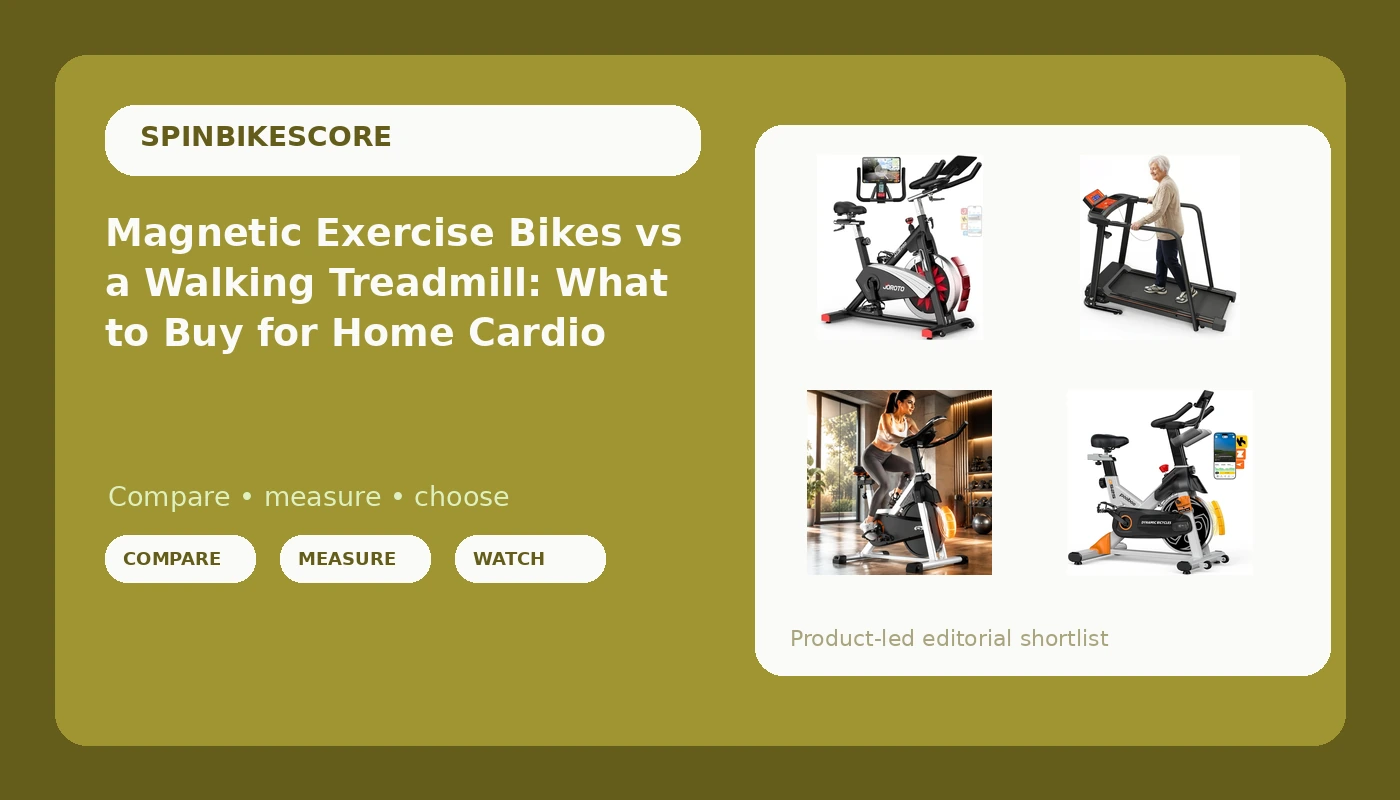
Buying a magnetic exercise bike for home cardio used to mean picking a flywheel weight and hoping for the best. Now the same category holds a compact magnetic bike, an app-connected magnetic bike, an indoor cycling bike rated to 400 pounds, and a walking treadmill with extra-long safety handrails. They all promise the same thing, which is that you will finally use the machine in the corner. They deliver that promise in four different ways.
The problem is that the specs printed on the box are not the specs that decide whether you keep riding in month three. What decides it is whether the bike fits your body, whether the resistance feels even across the whole range, and whether you actually want to sit on the seat. This is an explainer, not a scoreboard: it walks through what each of these four machines is built for, what magnetic resistance really changes, and how to choose without guessing.
Related: How Magnetic Resistance Actually Works on a Home Spin Bike →
Quick answer
If your goal is pedaling-based cardio and you have a spare corner, a magnetic stationary bike is the more versatile pick. It takes up less floor space than a treadmill, it is easier to move, and it works for steady rides, intervals, and standing climbs. If your goal is walking, balance support, or recovery work rather than cycling, the Lastforever walking treadmill with extra-long safety handrails is the more appropriate machine. The deciding factor is not which one burns more calories per minute. It is which one you will use four days a week.
Four useful options
| Model | Best fit | What stands out |
|---|---|---|
| JOROTO Exercise Bike, Magnetic Stationary Bikes for Home | Riders who want a straightforward magnetic bike without extra electronics | Magnetic resistance in a home stationary frame |
| pooboo Magnetic Exercise Bike, Indoor Stationary Bicycle for Home with App | Riders who want guided sessions and ride tracking | Magnetic resistance plus app connectivity |
| Exercise Bike, Magnetic Stationary Bikes for Home Cardio with Brake Pad Silent Belt Drive, 400LB Weight Capacity Indoor Cycling Bike with Adjustable Seat & Water Bottle Holders for Adults & Seniors | Heavier riders and shared households | 400 lb weight capacity, brake pad and silent belt drive, adjustable seat, water bottle holders |
| Lastforever Walking Treadmill with Extra-Long Safety Handrails, Home Recovery Fitness Exercise Machine for Elder, Senior Treadmills for Home, Heart Rate Monitor, LED Display, 310 lbs Capacity | Walkers, older users, and anyone rebuilding strength | Extra-long safety handrails, heart rate monitor, LED display, 310 lb capacity |
Start here: JOROTO Exercise Bike, Magnetic Stationary Bikes for Home
The trade-off with a simple magnetic bike is that everything you want beyond pedaling has to come from somewhere else. There is no app to follow and no screen to read, so if you need a class voice in your ear to keep going, you will be running that from your phone or a tablet propped on the handlebars. What you get in return is a machine with fewer failure points and a resistance system that does not consume pads. For a rider who already knows how to structure a workout, that is a reasonable trade. For a rider who needs the workout handed to them, it is not.
For app-guided riders: pooboo Magnetic Exercise Bike, Indoor Stationary Bicycle for Home with App
App connectivity is the feature that changes behavior most for new riders, and it is also the feature most likely to disappoint. Some apps are genuinely good: they cue intervals, they count the ride, and they give you a reason to clip in on a Tuesday. Others are a basic timer with a login screen. Before you buy any app-connected bike, check which app it uses, whether the app still receives updates, and whether the core functions work without a paid subscription. A bike that becomes a paperweight when the app is discontinued is a worse purchase than a bike that never had an app at all.
For heavier riders and shared households: Exercise Bike, Magnetic Stationary Bikes for Home Cardio with Brake Pad Silent Belt Drive, 400LB Weight Capacity Indoor Cycling Bike with Adjustable Seat & Water Bottle Holders for Adults & Seniors
Weight capacity is the most misunderstood number in home fitness. It is a ceiling, not a target, and it covers static load rather than the dynamic load of a rider standing and sprinting. A bike rated to 400 pounds used by a 250 pound rider has real headroom. The same bike used by a 390 pound rider does not, especially if that rider likes to climb out of the saddle. The second thing capacity buys you is stability: a frame built to hold more weight is generally a frame that stays planted, which is the single most important safety property of any indoor bike. Adjustability is the quiet bonus here, because a seat that moves through a wide range is what makes one bike work for a household with two very different riders.
For walking and balance work: Lastforever Walking Treadmill with Extra-Long Safety Handrails, Home Recovery Fitness Exercise Machine for Elder, Senior Treadmills for Home, Heart Rate Monitor, LED Display, 310 lbs Capacity
This is the one machine here that is not a bike, and the differences run deeper than the shape. Walking is lower impact than pedaling and easier to sustain for long, slow sessions, which makes it a better fit for recovery work and for anyone whose knees or hips object to cycling posture. The extra-long handrails are the safety feature that matters most, because a walking treadmill without adequate hand support is a fall risk for exactly the user it is marketed to. The trade-offs are floor space, weight, and the fact that walking takes longer to reach the same cardiovascular intensity as a hard bike interval. If you want thirty sweaty minutes, the bike wins. If you want forty-five minutes of easy movement you will actually repeat, the treadmill has a real case.
Prices and availability may change. Product images, names, and retailer links must be matched by verified ASIN. Do not state a current price, rating, stock status, or measured result without current evidence.
What magnetic resistance actually changes
On a magnetic bike, resistance comes from magnets that move closer to or farther from the flywheel as you turn the knob. Nothing touches the wheel. On a felt-pad bike, a pad presses against the flywheel, and that pad is a wear item: it sheds material, it glazes, and it starts grabbing unevenly as it ages. The difference shows up in three places.
- Smoothness across the range. Magnets give a more even ramp from easy to hard, which matters when you are adding resistance in small steps during intervals.
- Dust and feel over time. A felt pad changes how the bike rides as it wears. A magnetic system does not have that particular failure mode.
- Consumable parts. There is no pad to replace, so the resistance mechanism has one less thing to service.
Magnetic resistance is not automatically better. A well-built felt bike beats a flimsy magnetic bike every time, because frame flex and a slipping resistance knob ruin a ride faster than a pad ever will. Belt drive is a separate decision: a belt runs quieter and needs less maintenance than a chain, which is why so many home bikes now use one. The listed 400 lb bike here combines a brake pad with a silent belt drive, which is worth understanding before you buy, because brake pad resistance and magnetic resistance feel different at the top of the range.
How to match a machine to your body and your room
Fit is the spec nobody prints. Two riders can buy the same bike and have completely different experiences because one of them has the seat at the right height and the other does not. The numbers worth checking before you order:
- Decide whether your cardio is pedaling or walking. This is the first decision, not the last. Cycling is easier to make intense in a short window; walking is easier to sustain and easier on joints.
- Measure your inseam and your floor space. Your leg should be almost straight at the bottom of the pedal stroke with a slight knee bend. If the seat post will not go high enough for your inseam, the bike is wrong for you no matter how good the specs look.
- Check the listed weight capacity against the heaviest person who will use it, and leave margin for dynamic movement during a standing climb.
- Decide whether you want an app or a subscription. If you do, confirm which app the bike uses and whether the core features survive without paying monthly.
- Confirm adjustability and the return window. An adjustable seat is what lets one bike serve two riders, and a return window is your only real protection if the seat turns out to be uncomfortable.
Before you buy
- Measure the footprint and the ceiling clearance, then add space for getting on and off the machine.
- Plan on replacing the saddle. The seat is the first upgrade on most home bikes, and a $40 saddle can rescue a bike you were about to give up on.
- Check whether the pedals accept standard cycling shoes or only the cages that ship in the box.
- Read the listing for the resistance type, not the marketing name. Magnetic and felt pad are different ownership experiences.
- Decide where the machine goes before it arrives. A bike in a hallway is a bike you will not ride.
Which option should you choose?
Choose the JOROTO Exercise Bike, Magnetic Stationary Bikes for Home when you want a simple magnetic bike and you already know how to structure your own workout. Choose the pooboo Magnetic Exercise Bike, Indoor Stationary Bicycle for Home with App when guided sessions and ride tracking are what keep you consistent. Choose the Exercise Bike, Magnetic Stationary Bikes for Home Cardio with Brake Pad Silent Belt Drive, 400LB Weight Capacity Indoor Cycling Bike with Adjustable Seat & Water Bottle Holders for Adults & Seniors when the rider is heavier, when two people will share the machine, or when stability at sprint resistance matters most. Choose the Lastforever Walking Treadmill with Extra-Long Safety Handrails, Home Recovery Fitness Exercise Machine for Elder, Senior Treadmills for Home, Heart Rate Monitor, LED Display, 310 lbs Capacity when walking, balance support, and recovery work are the actual goal rather than cycling.
One caveat applies to all four. None of these listings publishes the two numbers that would settle the argument for you: the actual flywheel weight and a measured noise reading from a real ride. Those are the details that determine how a bike feels in year two, and they are the details you cannot verify from a product page. Check the manufacturer documentation, look for the warranty terms, and treat the return window as part of the purchase.
The bottom line
The gap between budget and mid-range home cardio machines has narrowed, mostly because the mid-range got simpler rather than because the budget tier got better. What still separates a machine you keep from a machine you sell is fit and stability, and neither of those shows up in a headline spec. A magnetic bike that fits your inseam and stays planted when you stand will outperform a more expensive bike that does not. A walking treadmill with handrails you can actually reach will get used by the person it was bought for. Pick the machine that matches the way you train, check the weight capacity and the adjustability against your own numbers, and treat the seat and the app as part of the total cost rather than an afterthought.